


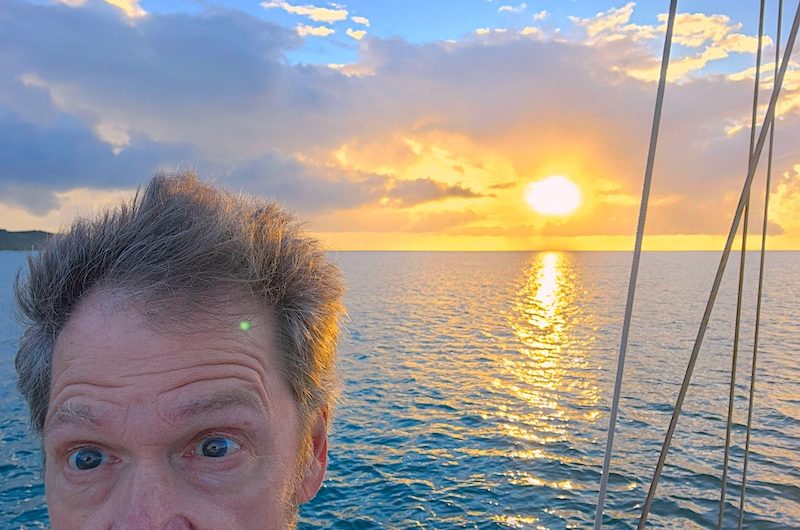
March 27/2025: I wanted to take a more “cruiserly” approach to bringing Lunacy back to North America from the Caribbean this year, and I also decided it was well past time to get my shoal-draft centerboard boat into Bahamian waters for a change. Thus the hatching of an obvious plan: to island-hop from the south coast of Puerto Rico, where Lunacy was based this past winter, to the southeast U.S. via the various little (and larger) bits of land in between.
I was particularly interested in the Bahamas. I had sailed there only twice before, a long time ago. First in December of 1980, in the Abacos, on a two-week family charter with my parents and younger brother Peter, as a salve for my mother, who absolutely could not bear the thought of a Christmas at home without my youngest brother Harry, who was killed in a car accident earlier that summer.
I remember this as a rather chilly cruise, as we were not quite far enough south to escape the shadow of the continent’s early winter weather. Just as we could not quite escape memories of my departed brother. I remember too that our hired skipper and I got a gig playing guitar and singing a few songs in a small restaurant where we celebrated Christmas Eve. And the cook in the kitchen was so offended by our very secular playlist (and probably also our lack of talent), that she stormed out on stage with a rub-board and spoon and took over the show.
This is one calypso refrain of hers I shall never forget: “Let us come… come… come… come… come let us adore Him!!!”
The second time was in late 1992, when I was crewing on an Aussie boat, a Taswell 56 named Antipodes, and we sailed from the Canary Islands to San Salvador in the Bahamas, recreating Columbus’s route in Jimmy Cornell’s America 500 rally. From San Salvador the rally fleet, well over a hundred boats, gathered at George Town, Great Exuma, where vast post-rally festivities took place. Both the owner and skipper of Antipodes afterwards decamped for Christmas and the holidays, leaving the Kiwi first mate Simon and I babysitting the boat for six weeks, anchored off Stocking Island.
Needless to say, we had a fabulous time.
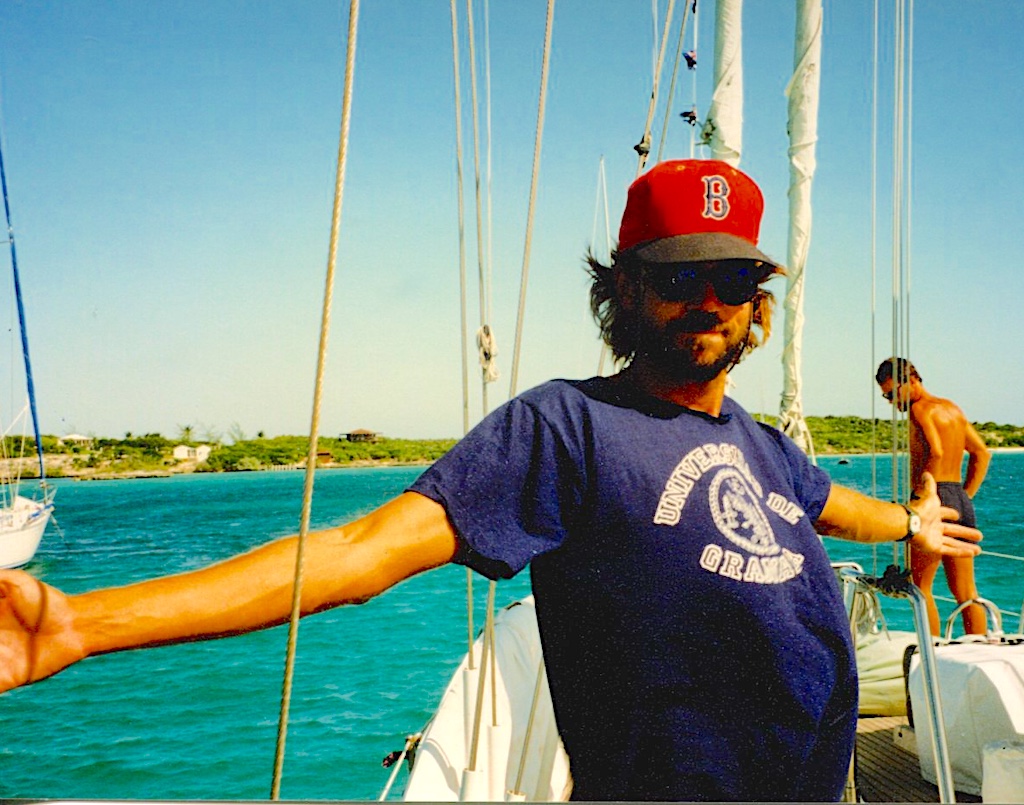
I gave some thought now as to whether I might manage Lunacy solo on a route through the Bahamas, but with the prospect of both some fairly tactical navigation and perhaps unpredictable traffic, I decided it would be best to have crew. None of my usual suspects were available for what I expected would be a full month afloat, so I tapped Hank Schmitt’s OPO network and recruited two fine fellows, Bill Hotaling and Michael Agerbak, to come along for the ride.
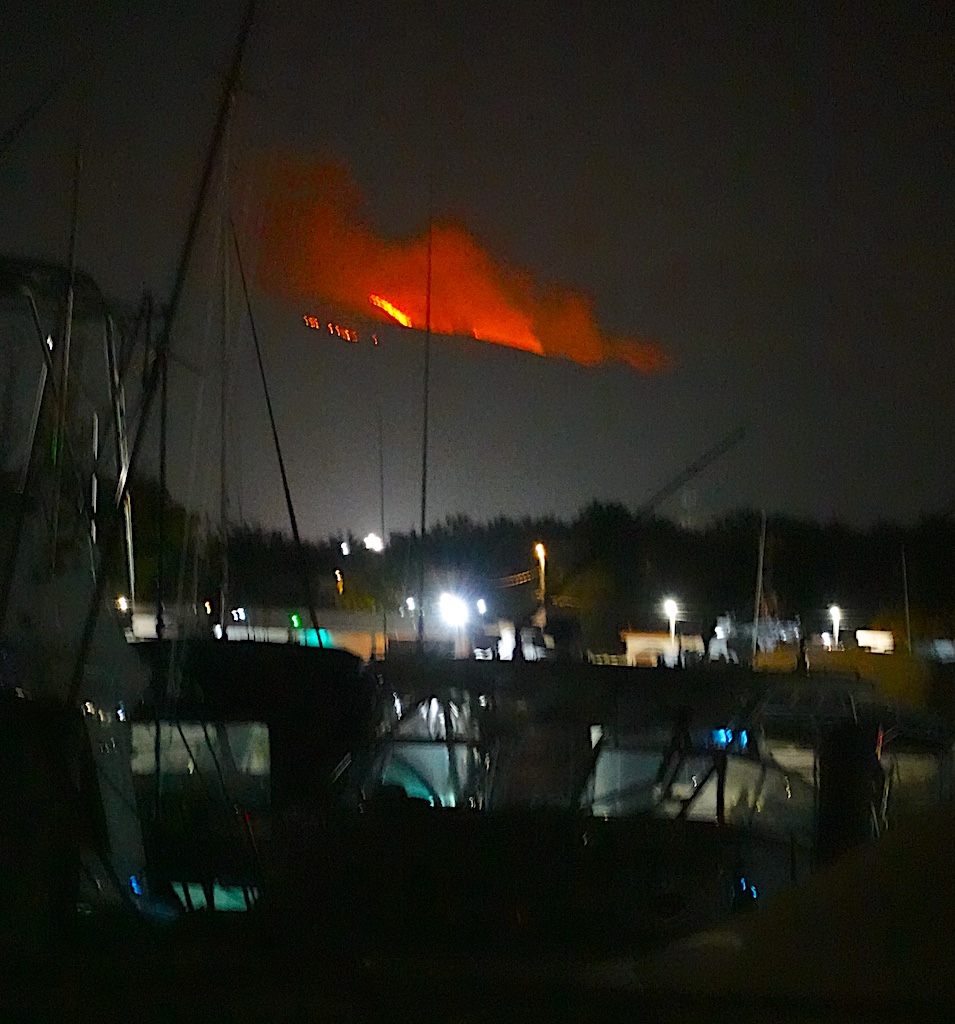
We gathered aboard Lunacy in the Marina de Salinas in Puerto Rico over the course of three days in mid-February. I drove the boys without mercy on two forced hunger marches with packs and bags to the local Econo market, over a mile from the marina, so as to provision the boat. During our first night all aboard together, we couldn’t help but notice that the mountains to the north of us had burst into flames… a seemingly ominous event!
The first leg of our cruise was a short one, just 20 miles from Salinas to Ponce, downwind along the coast under headsail alone. Here we hooked up with Don Joyce, on his very unique vessel, Cat’s Meow, at the Ponce Yacht & Fishing Club. Don and I have been online acquaintances for some time, but we had never actually met in person. Cat’s Meow is super impressive, a custom 78-foot catamaran cum trimaran with a centerline daggerboard that was designed by Derek Kelsall. Don and his wife, both in their 70s, sail this massive boat as a couple.
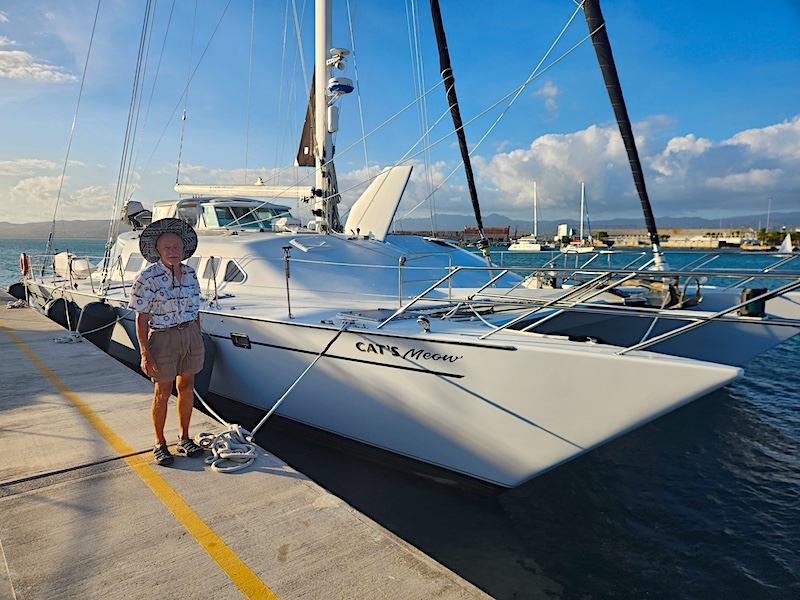
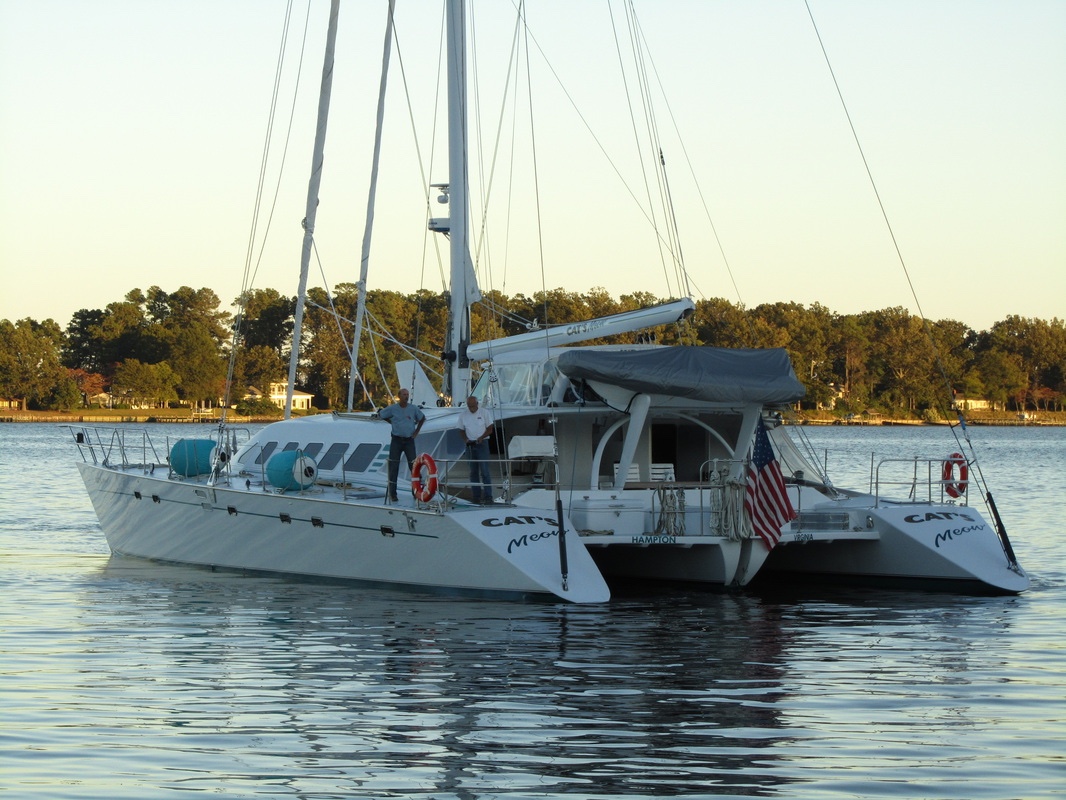
Don purchased Cat’s Meow at a U.S. Treasury auction, after she was seized as a drug boat that had been smuggling hash oil from Jamaica to Florida. According to Don, she and her crew were busted after the Feds somehow managed to sneak some dock fenders aboard with transponders hidden inside. Don decided not to change the boat’s name, so has been hassled a few times since sailing her in and out of the U.S. He expects he may sell her soon and thinks she would make a great charter vessel.
While in Ponce we topped up on diesel at the club’s fuel dock (the cheapest, cleanest diesel in Puerto Rico, so says Don!) and got a chance to inspect some tragically recent fire damage. Evidently a boat in one slip at the club went up in flames and seared a neighboring catamaran that was practically brand new.
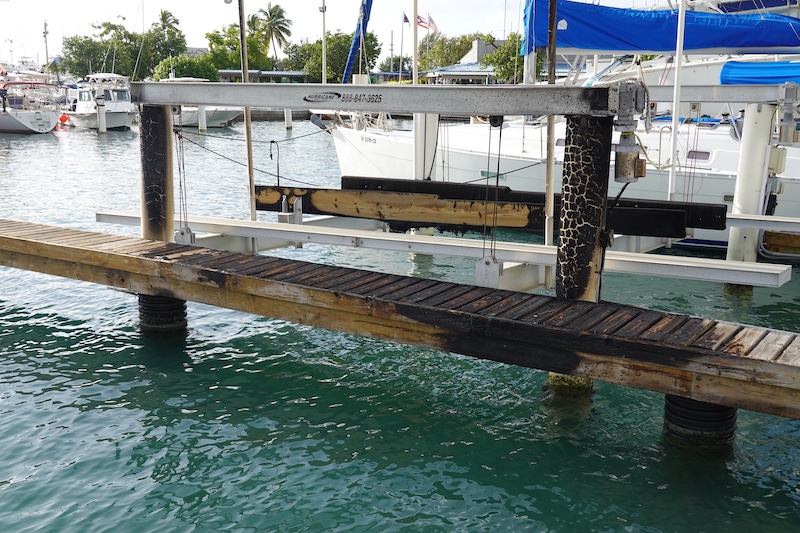
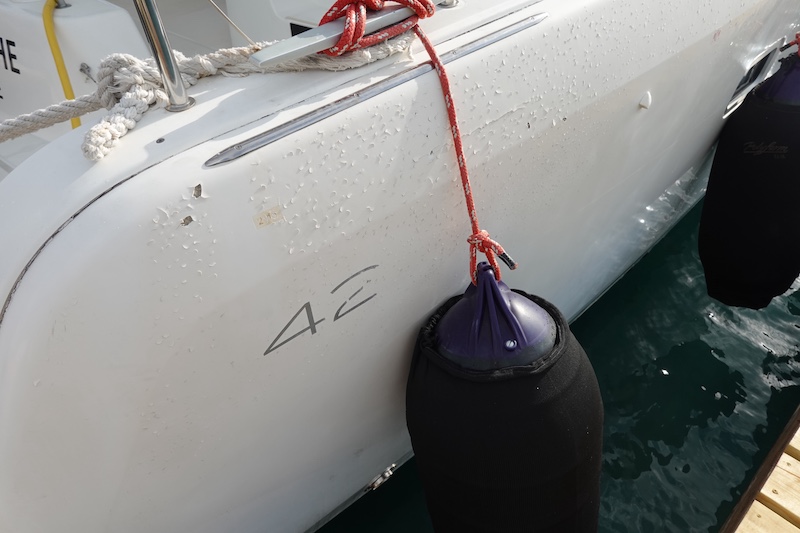
Now the owner of the cat and his insurance company have some haggling to do.
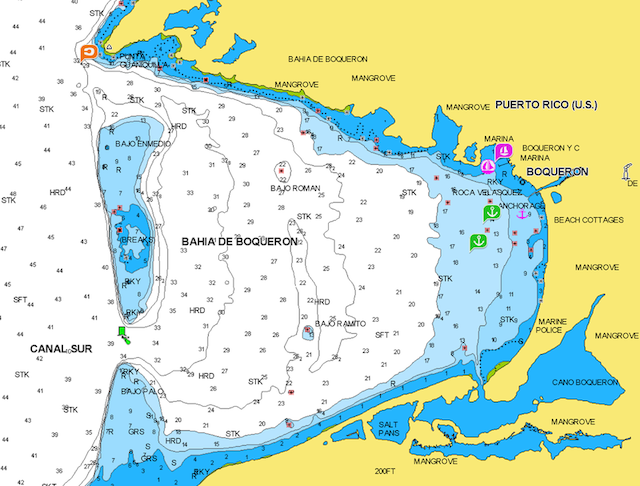
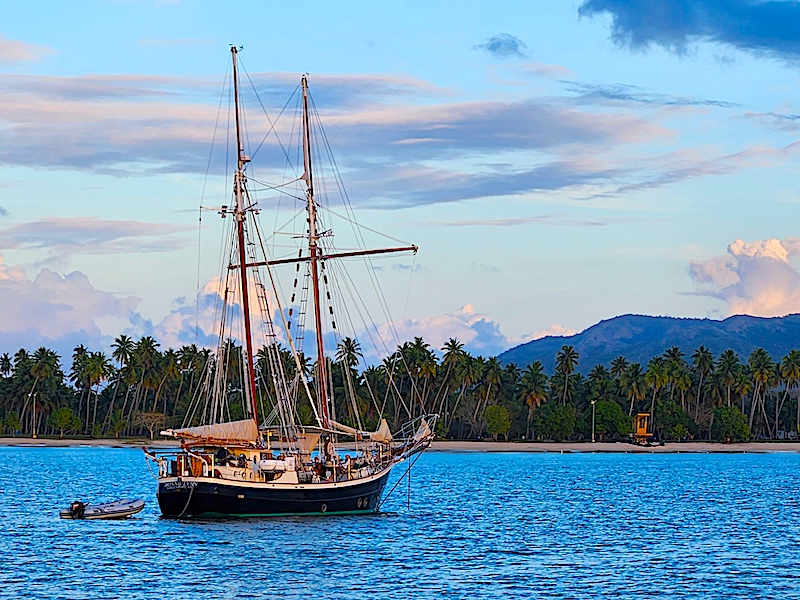
Directly after taking on fuel at Ponce we noodled down the coast some 40 miles, again downwind under headsail alone, to Boqueron, at Puerto Rico’s southwest corner. We arrived just before sunset and anchored near a hermaphrodite-type schooner named Bonnie Lynn, out of Greenport, New York.
I had been here before, while researching my biography of Thomas Tangvald, The Boy Who Fell to Shore. Back in the 1980s, Boqueron was a major gathering point for Caribbean cruisers, and the Tangvald family spent a great deal of time here. Peter Tangvald’s last child, Thomas’s half-sister Virginia, was born here aboard Peter’s boat, L’Artemis de Pytheas, back in October of 1986. But these days, though Boqueron boasts a large, well-protected anchorage with room for many boats, few cruisers stop here.
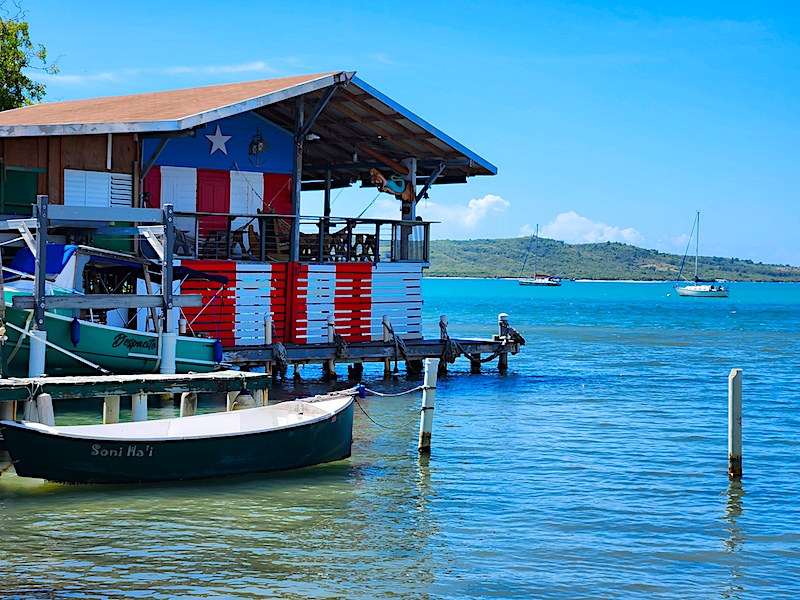
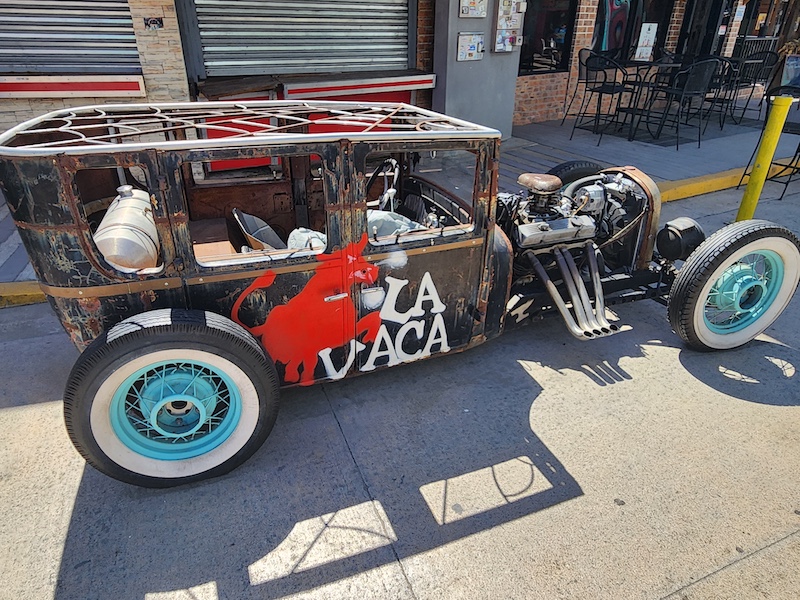
We had some fun meeting the owners of Bonnie Lynn, a couple named Erick and Hannah, who work her in the charter trade. And when Bill, Michael, and I ventured ashore for a wander, we found the town was quite neat and tidy by Puerto Rican standards, with an active tourist trade, a boutique mangrove forest, and an immensely long beach.
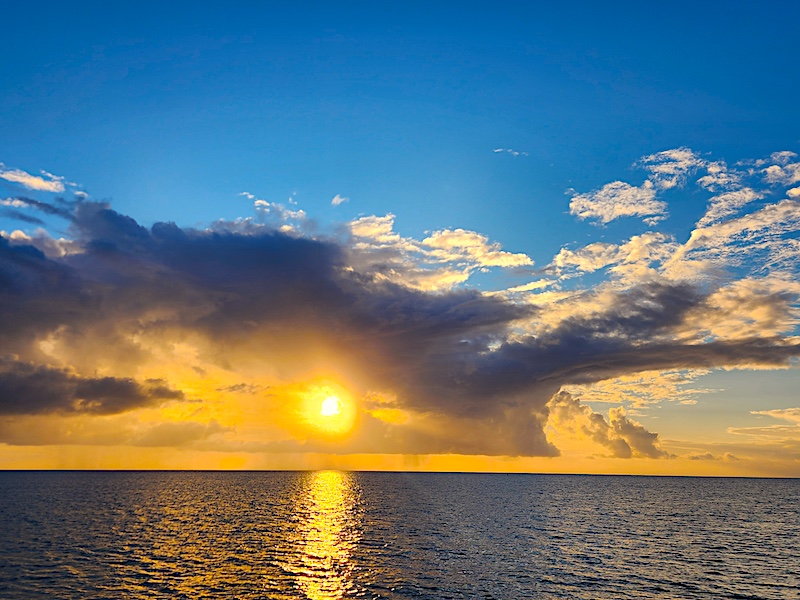
From Boqueron, on the last Saturday in February, we struck out for the Bahia de Samana on the north coast of the Dominican Republic, a run of some 150 miles. We had to motorsail for a couple of hours to get out of Puerto Rico’s big wind shadow, but once we found the breeze, a brisk northeasterly, we were fast and covered the distance in less than 24 hours.
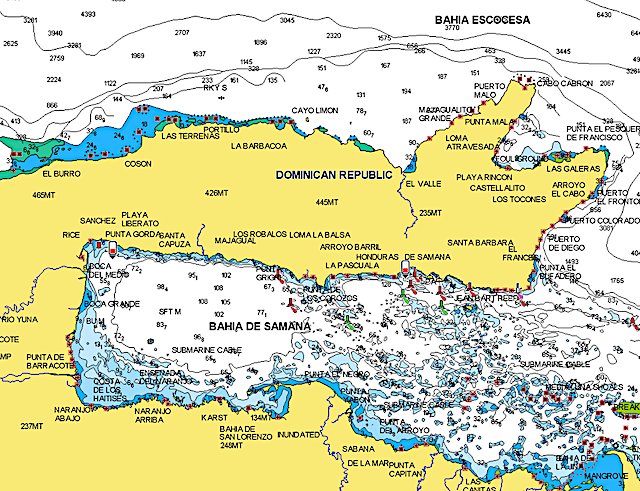
Booking into the DR, I’d been told, can be a fraught experience. I’d heard tales of transient cruisers getting shaken down for beaucoup bribes by underpaid government officials. Rumor has it officials based in marinas are the most user-friendly, so we landed at the Marina de Puerto Bahia, a deluxe joint in a fancy hotel/condo complex on the north shore of the bahia. The officialdom here, consisting of the Armada (the Dominican navy), customs, and immigration, were indeed friendly, but not highly efficient, and were hampered by a stuttering electrical system that greatly complicated data entry.
February, it turned out, is whale-watching season in the Bahia de Samana, as this is when humpbacks come here to make more whales. At the height of the season there can be as many as 300 whales in residence. The fanciest boat in the marina taking folks out to peer at the animals was this one here, a very futuristic-looking Wave 60 catamaran.
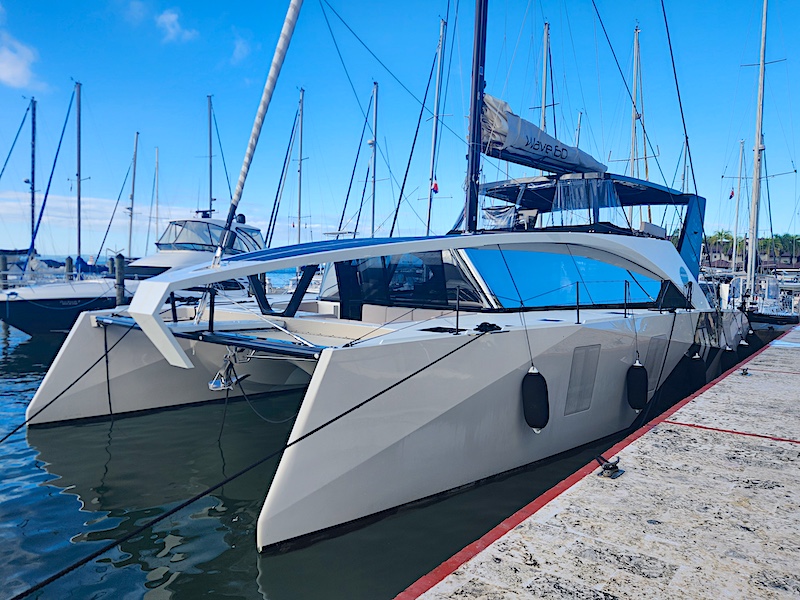
A new one on me… just when I thought cruising cats couldn’t get any weirder. Evidently these boats are built in Poland and were introduced just last year.
I had thought we might explore the DR by boat a bit, at least take a short jaunt to the national park across the bay and maybe meet some whales along the way. But it turns out moving a foreign yacht from any one place in the DR to any other place, even if they are very close together, involves multiple transactions with the officialdom. So we limited our exploration to a taxi ride into the nearby town of Santa Barbara de Samana. No permit required.
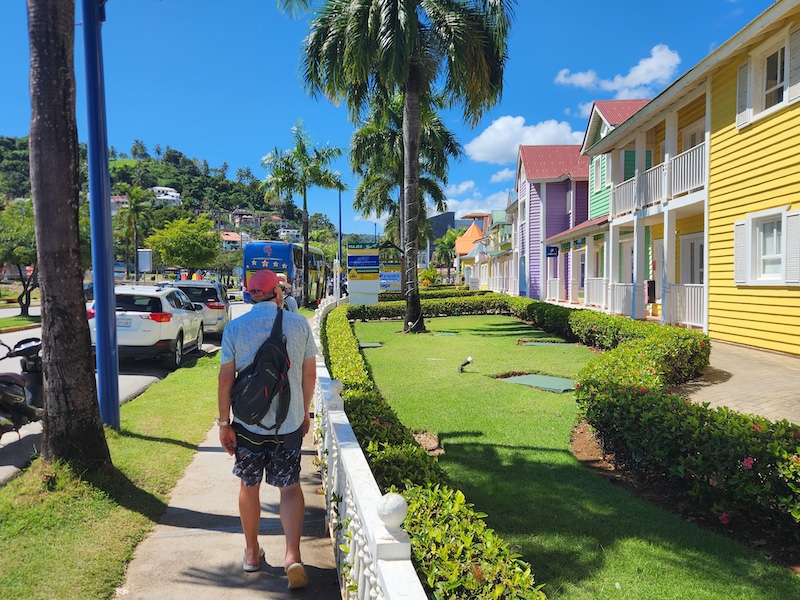
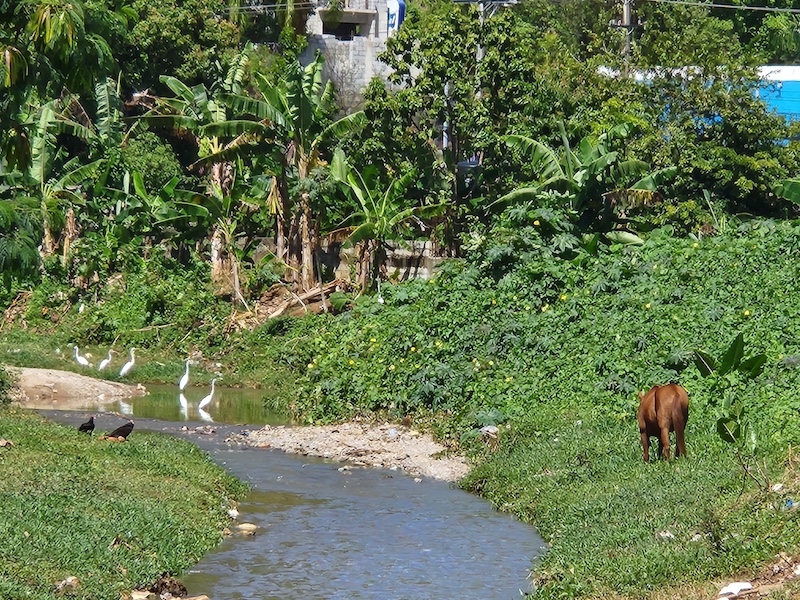
And no… your eyes do not deceive you. Those are in fact vultures, some egrets, and a stray horse, all spotted in downtown Santa Barbara.
Departing the Bahia de Samana, we saw many whale-watching boats, but no whales. We also saw quite a few small fishing skiffs tending drift nets and a few times had to work to avoid them. The total distance from Samana to Great Inagua, the southernmost Bahamian island, is about 300 miles, which we covered in a little more than two days. This during a mild frontal passage, which saw us sailing at all possible angles. The denouement was a fine late-afternoon A-sail set in light air that morphed into stronger air just around the sunset that led us into our second night at sea. The dark hours of the next morning found us sailing downwind under just a reefed main watching lightning crackle in the distance, first to the south over Haiti, then later way off in front of us.
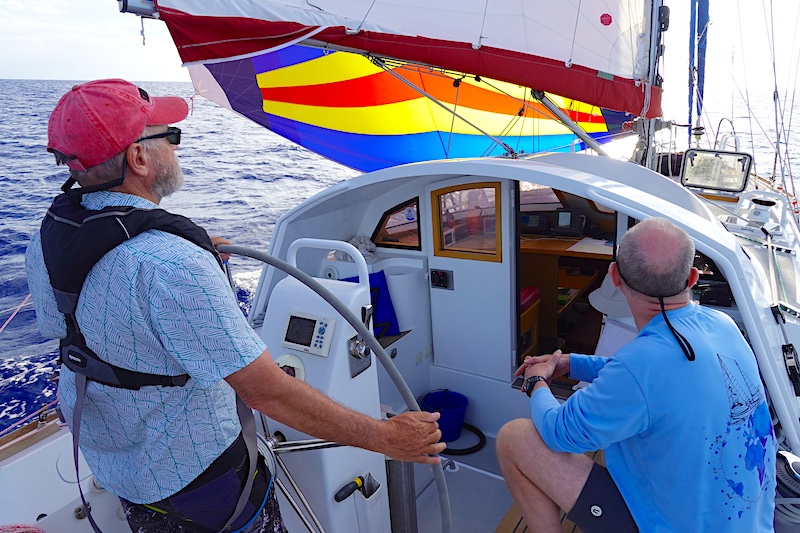
We arrived and anchored in the open roadstead off Matthew Town, the metropolis of Great Inagua, in the early afternoon. I had no trouble booking in, though the immigration people did charge $40 for working overtime at 2pm on a Thursday and cheerfully handed me a receipt attesting to this.
Not long afterward there appeared a vision—a great butterfly of a traditional vessel, flying a vast patchwork mainsail on a sort of sprit rig that resembled a Polynesian crabclaw, behind a colorful striped headsail. I watched in amazement from Lunacy’s cockpit, eyes glued to my binoculars, as this creature crept along the shore, then darted into the rather cramped government basin and parked on the wall in there, all under sail alone.
On going ashore next day, we learned this creature was in fact a Haitian trading vessel that routinely appears at Matthew Town to deposit fresh produce and collect various goods in return. Appropriately named Thank You God, she is incredibly primitive: no engine, no electronics, no running lights, with spars obviously hewn from solid tree limbs and raw wire and bulldog clamps for standing rigging. I tried to engage one member of the crew in conversation, but he could not (or would not) respond and stood paralyzed, seemingly traumatized… perhaps by conditions aboard the boat, perhaps by the awful situation back in Haiti, or perhaps by my execrable attempt to speak French.
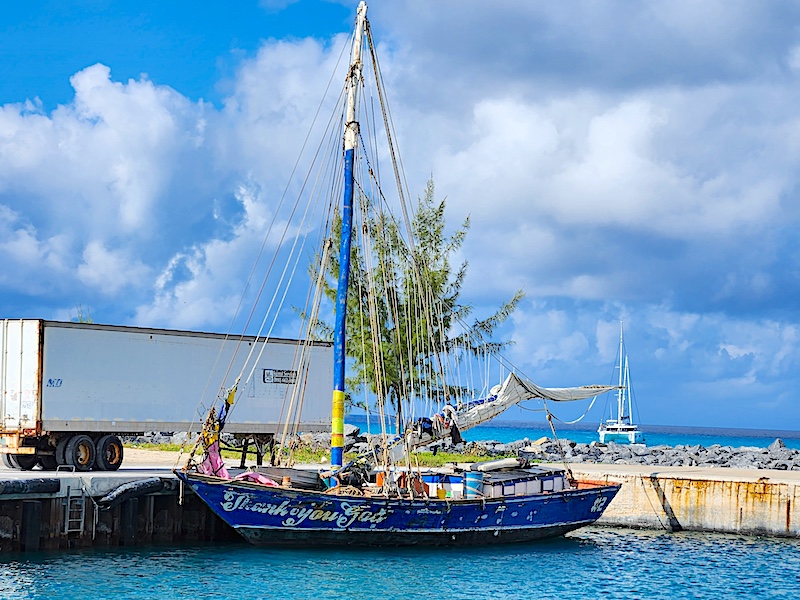
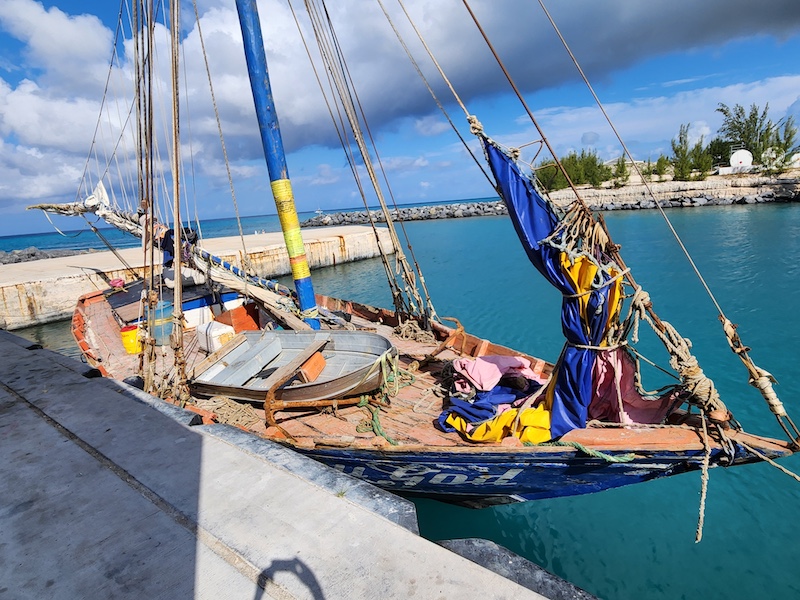
Later during our visit, we saw two more of these vessels sail in to join the first one.
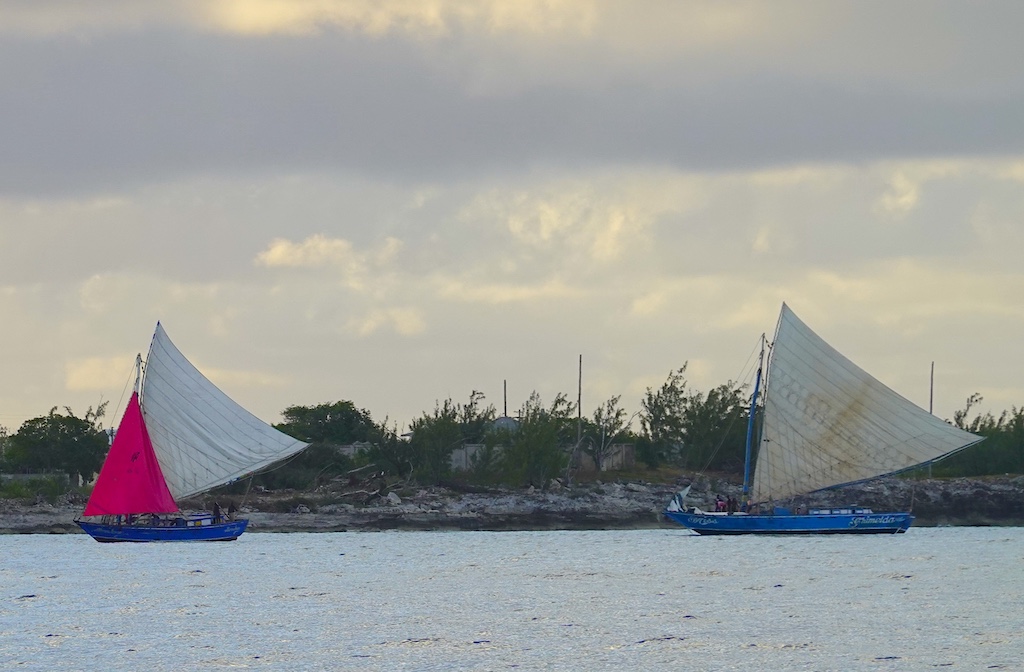
For the Haitians, I would assume, this is an important connection to the outside world.
Great Inagua, we learned, is quite remote and sees few tourists beyond the transient cruisers who stop here. The island is largely concerned with the manufacture of salt. Over a million pounds a year, courtesy of Morton Salt, which manages the vast evaporative salt pans that dominate much of the local landscape. There are also, we were told, many flamingos here, though we didn’t pony up for a car ride out to see them.
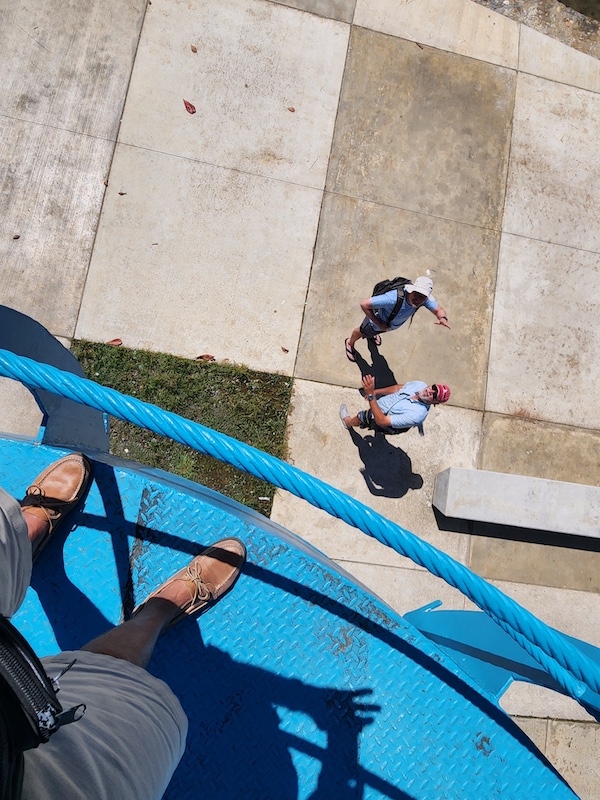
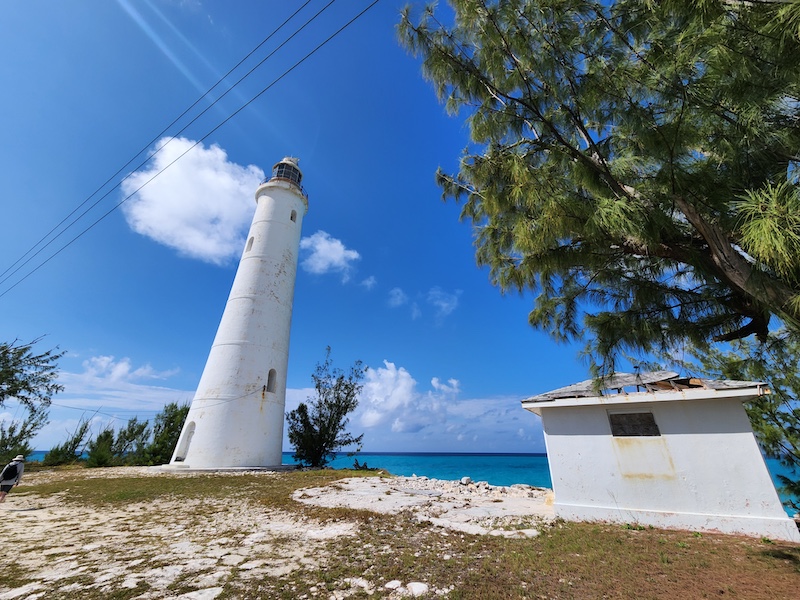
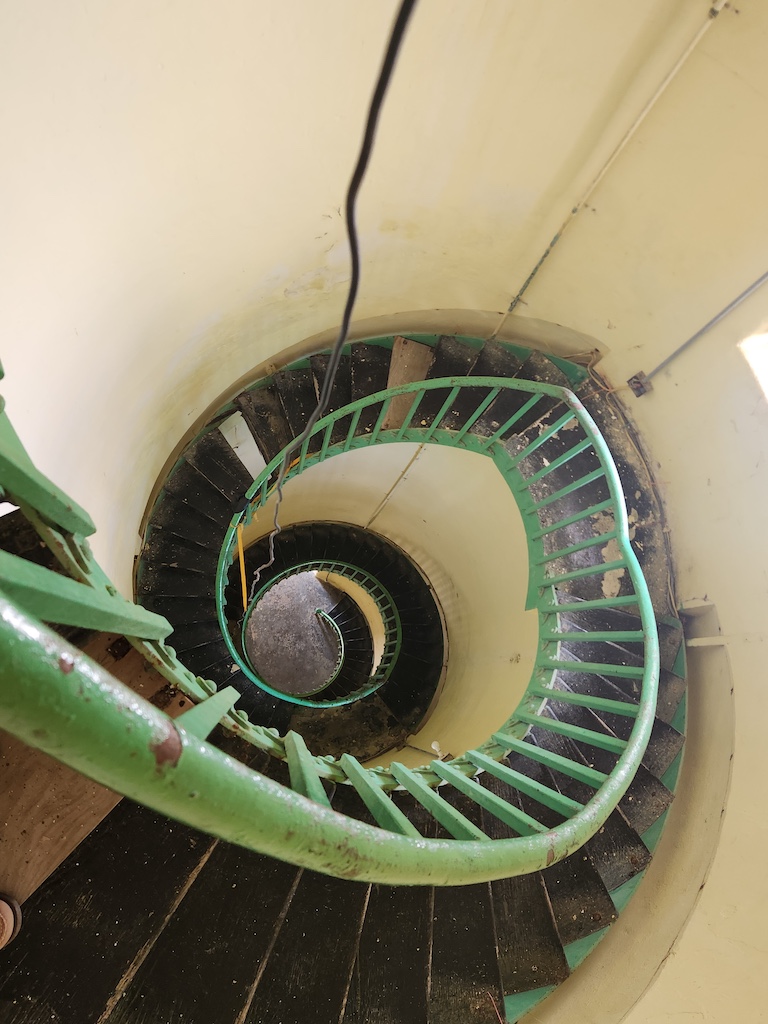
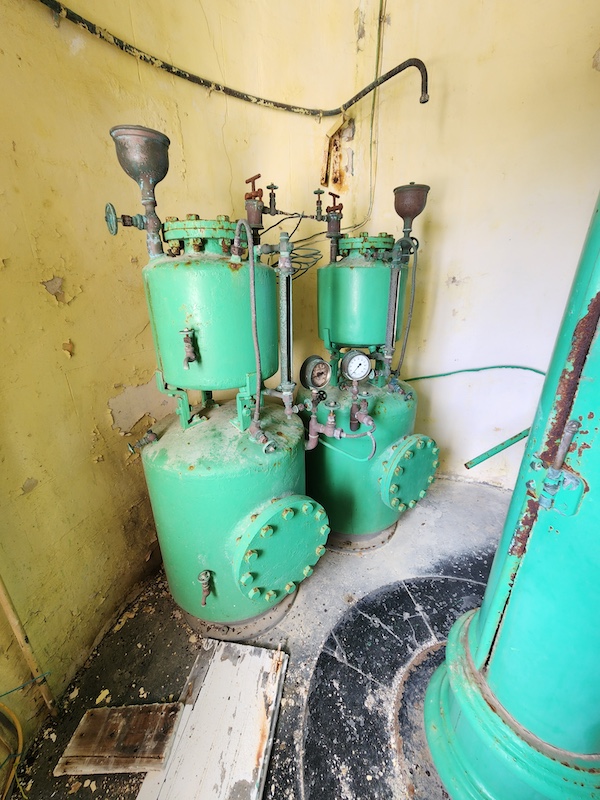
Instead we walked down to the old lighthouse that stands about a mile and a half south of town. This stands well over 100 feet tall, was built in 1870, and looks it. Originally the light was fueled with kerosene that was pumped by hand into tanks at the top of the tower. The light itself was also rotated manually with a mechanical hand gear. These days it is fully automated, powered by some solar panels and a 12-volt battery.
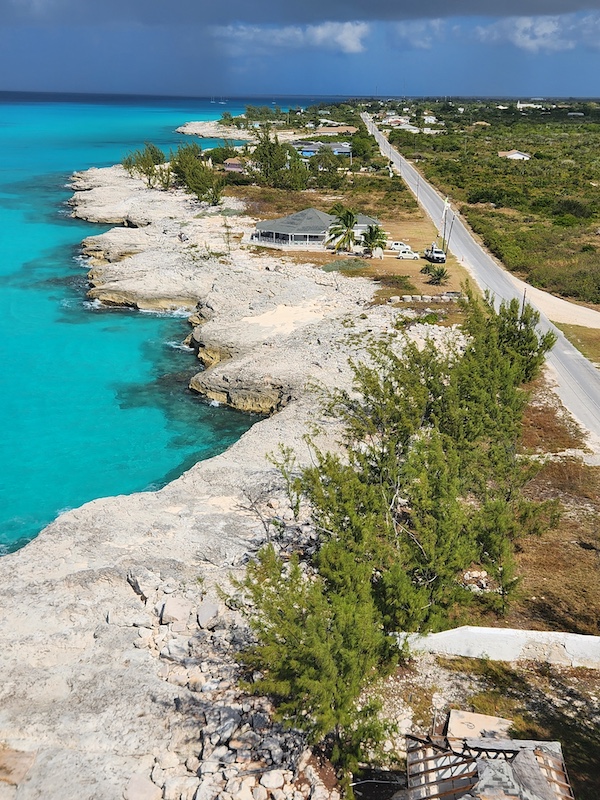
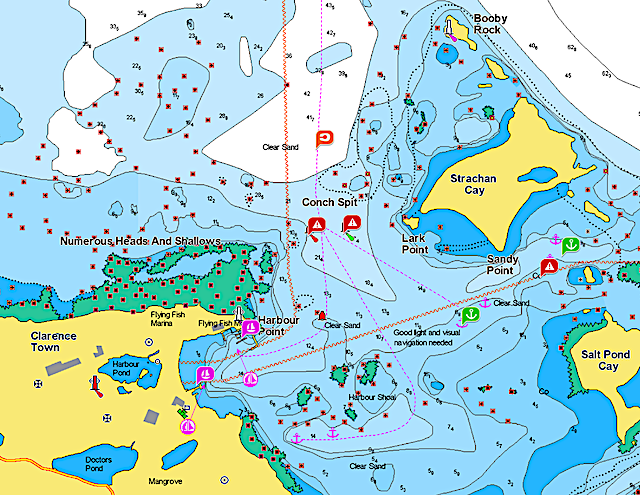
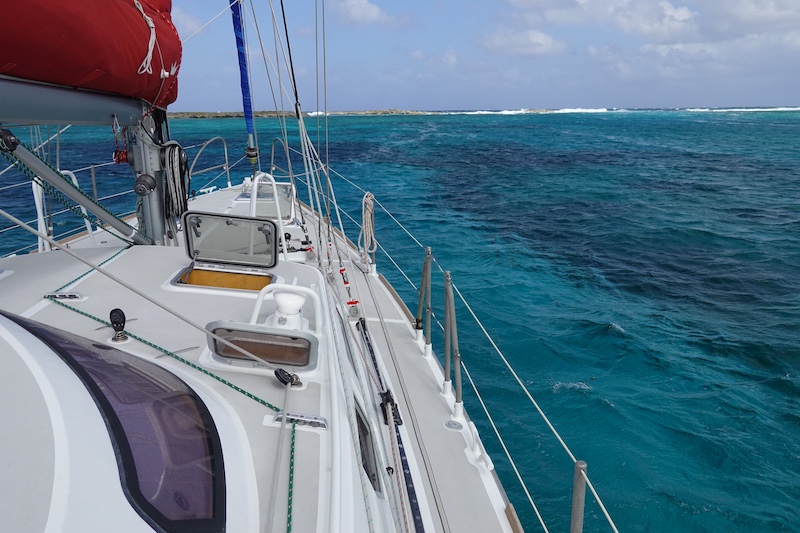
Sailing itineraries in the Bahamas are ruled by the tails of the cold fronts that periodically sweep through the archipelago, bringing sometimes quite strong northwest and northerly winds. The crux of the game is finding to places to hide from these winds when necessary. We were lucky our first frontal passage was weak enough to sail through, but the next one looked to be much stronger. After staring at charts for a bit, I decided we could hide from it at Clarence Town, on Long Island, about 150 miles northwest of Matthew Town. We enjoyed a fabulous sail most of the way there, running before a southeast breeze, and once arrived settled down in a well-protected nook east of the town behind Strachan Cay. Though it was a mile in the dinghy to get to town, we weathered the northerly breeze easily and were still reasonably well protected after the wind stayed strong and shifted back to the east.
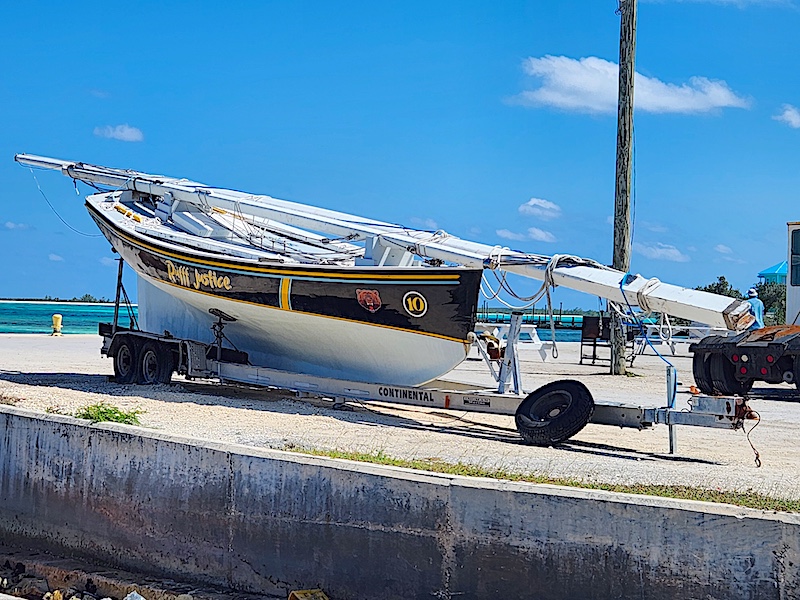
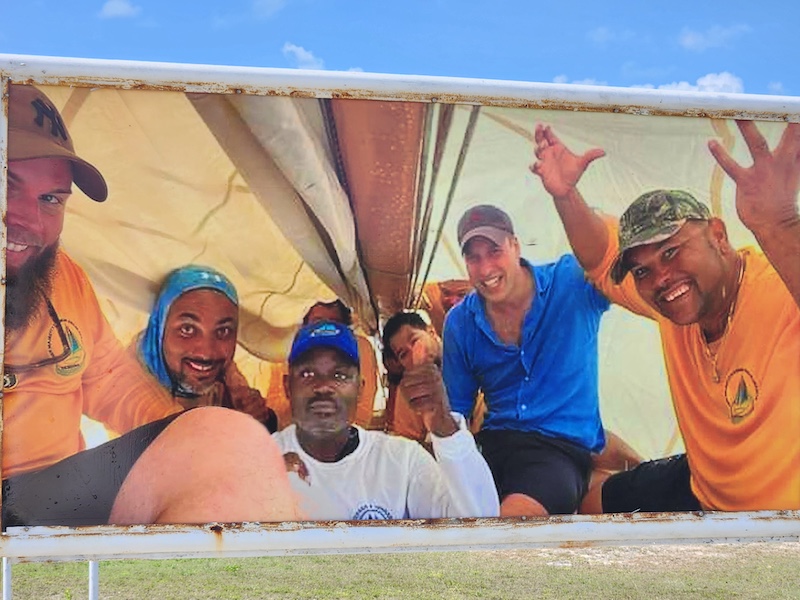
The very first thing we encountered on going ashore was a fine A-class Bahamian racing sloop, Ruff Justice, on a trailer on the government dock. We also found a big photo pasted to a sign on the outskirts of town that led us to believe William, the Prince of Wales, might once have raced on this boat. Googling around later, however, we learned William in fact raced on a local Long Island B-class sloop, Susan Chase V, at Nassau in 2022. We also learned that Ruff Justice had sunk while racing in April of last year, but was quickly refloated and salvaged.
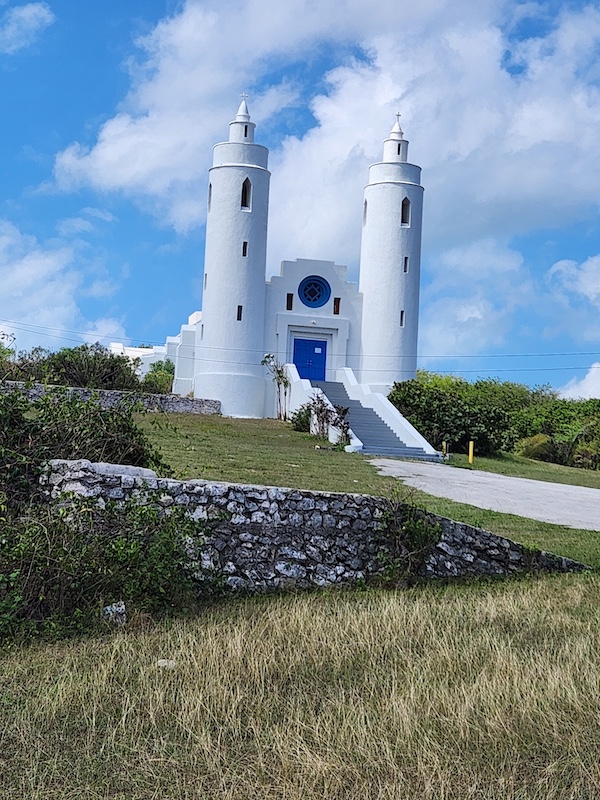
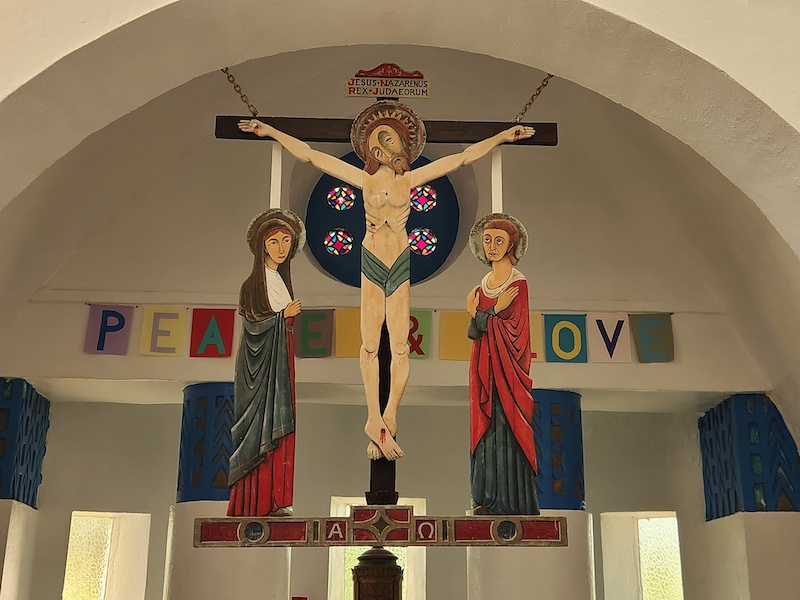
We also visited two fine churches, one Catholic and one Anglican.
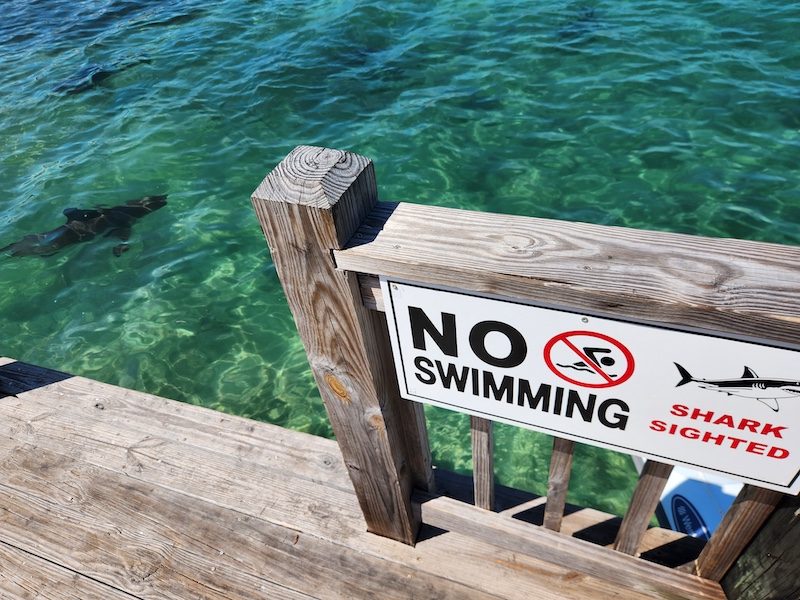
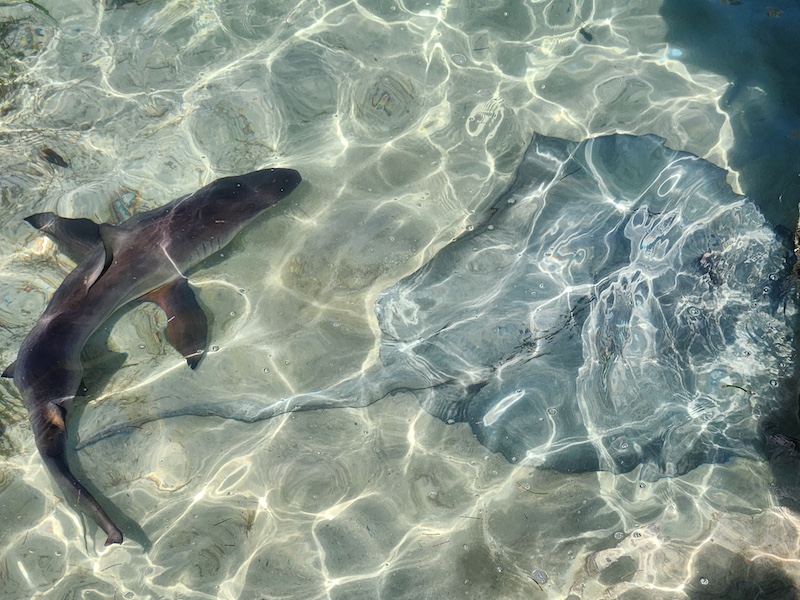
But the most impressive thing we saw at Clarence Town was a big scrum of eight sharks and a few rays thrashing all about the dinghy landing at the government dock. These were whipped into a feeding frenzy by an old gentleman who was busily cleaning fish on the dock and chumming the water with scraps.
The very first thing we had to do on leaving Clarence Town was decide where to hide from the next frontal passage. Again, it looked to be a strong one. I had originally thought we should visit George Town on Great Exuma, so I could witness firsthand how over-populated with boats it has become since I was last there in the ‘90s. But the wind, which was looking to veer southwesterly before howling from the north again, didn’t really want us to go there. So instead we went to Staniel Cay, further up the Exuma chain, which was just as well, as it too is a famous destination and I’d never been there before.
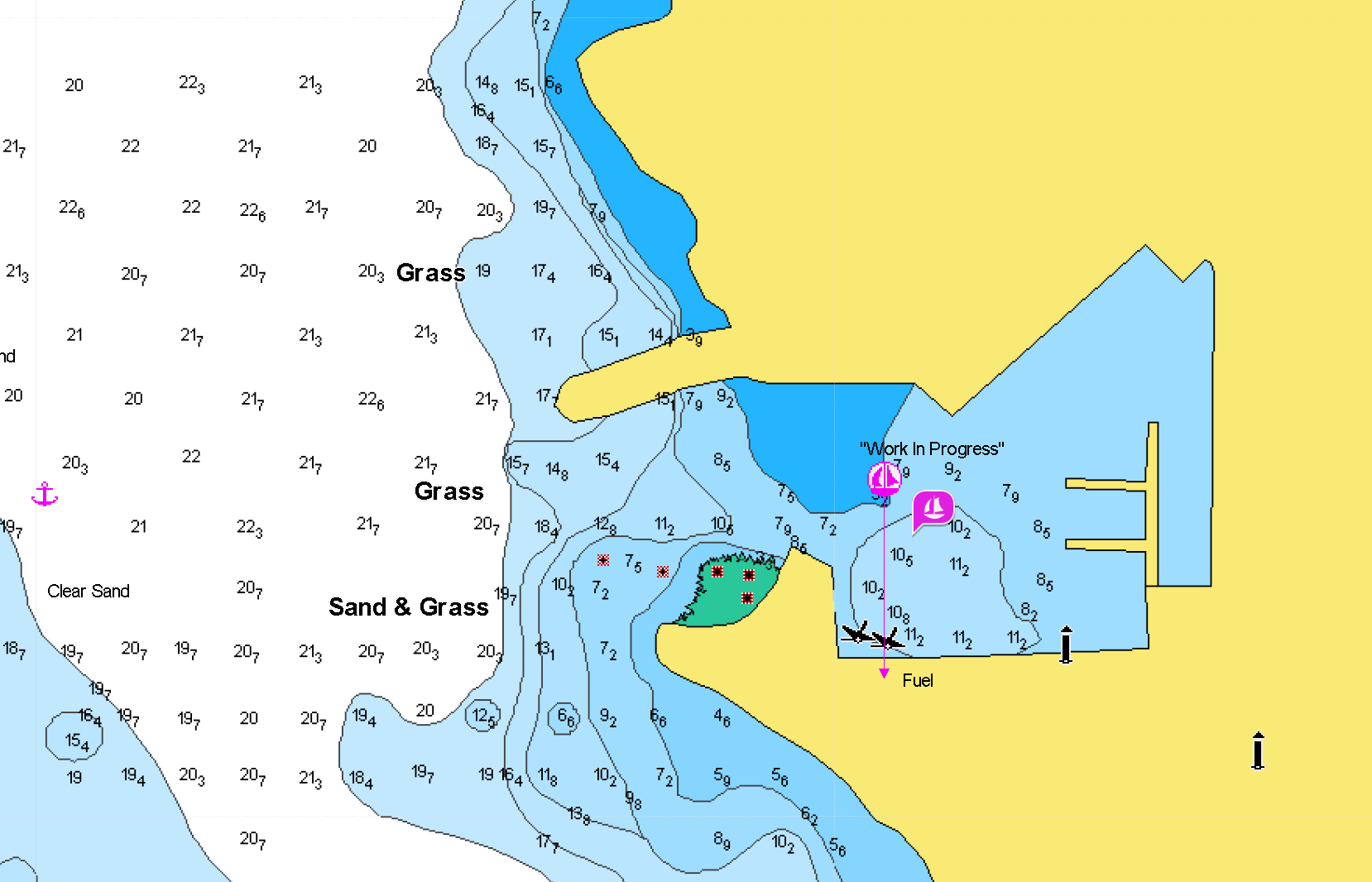
We selected as our hiding place a small shallow bay, not named on any of my three different charts, between the south end of Staniel Cay and Lumber Cay. None of my charts agreed as to the details of the place, and I got a bit confused coming in, wandering out of the shallow approach channel over an even shallower sandbar, but fortunately Lunacy’s very skinny draft (just 3ft 3in!) saved my butt. We were lucky to fit in with two other boats already there and got our anchor down in the nick of time, just before a rain squall and a big blast of westerly wind clapped on to us.
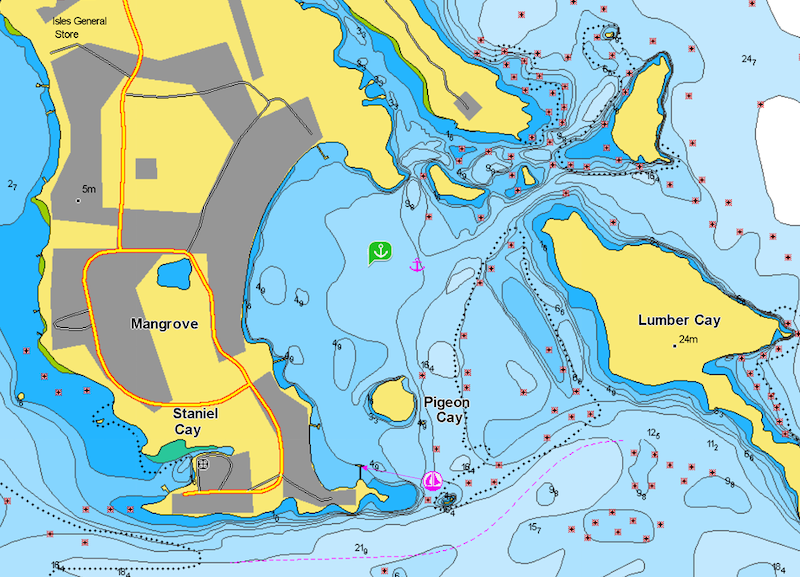
Of all the places we visited during our sojourn through the Bahamas, Staniel Cay was by far the busiest. From our first parking place off Lumber Cay, just south of the airstrip on Staniel, we saw small planes coming and going non-stop, and when we went ashore we saw many gringos, pale-faced and fresh from the U.S., trundling roller-bags off to wherever it was they were staying. Many, presumably, were headed for the several fancy vacation homes we saw looming about the place. On hiking over to the west side of the island, we found the docks of the famous Staniel Cay Yacht Club were nearly empty, thanks to the strong northwesterly wind, but the huge open roadstead west of the island was chock full of boats–60 or more, including a few superyachts way off in the distance–weathering the blast as best they could.
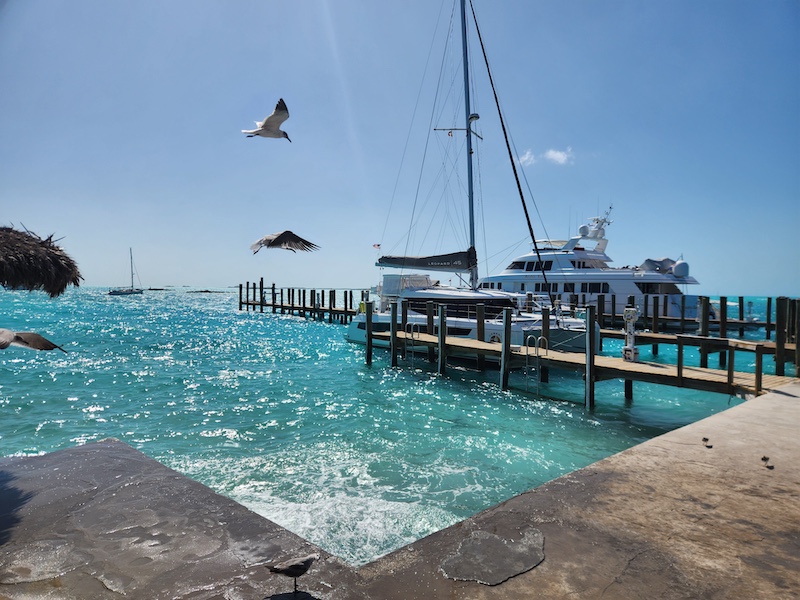
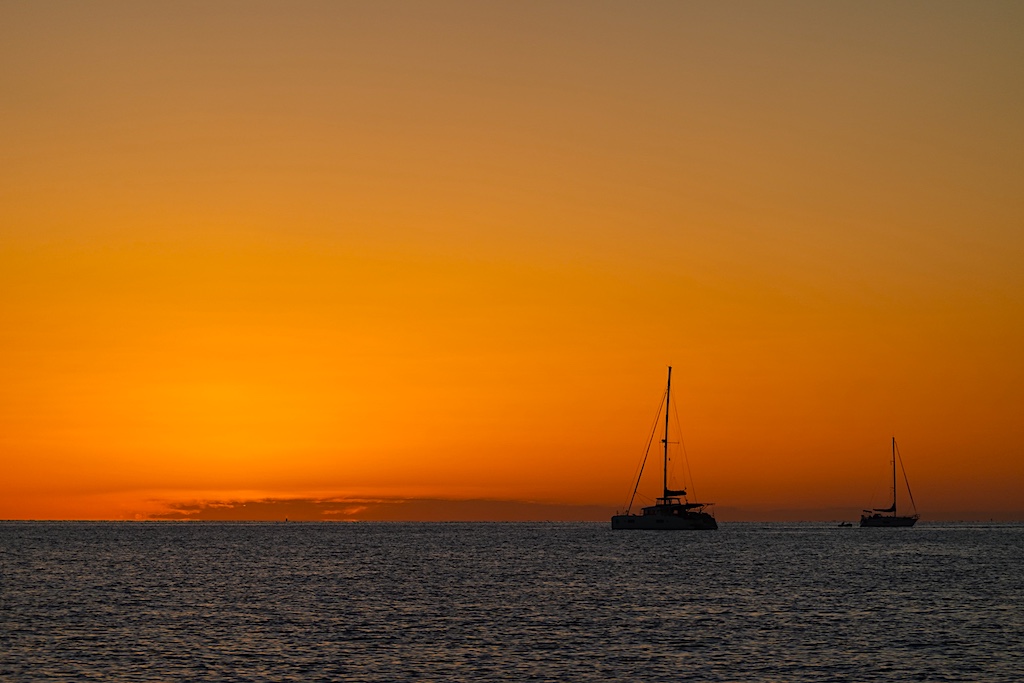
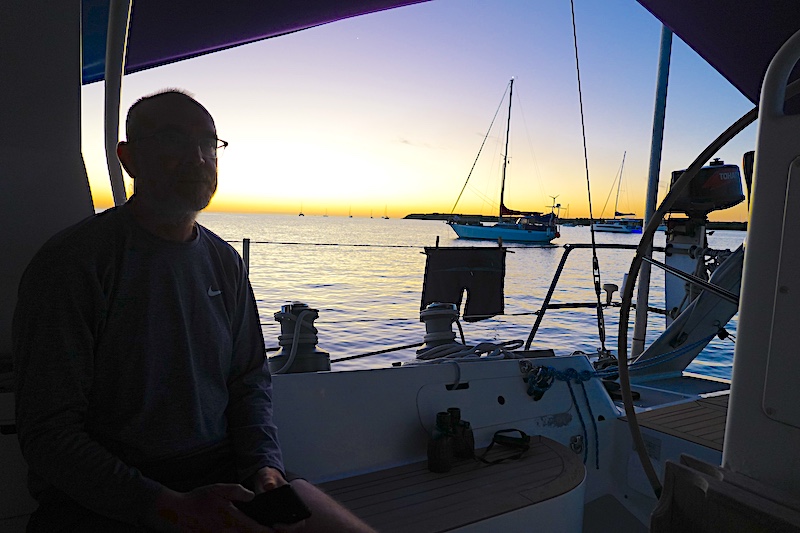
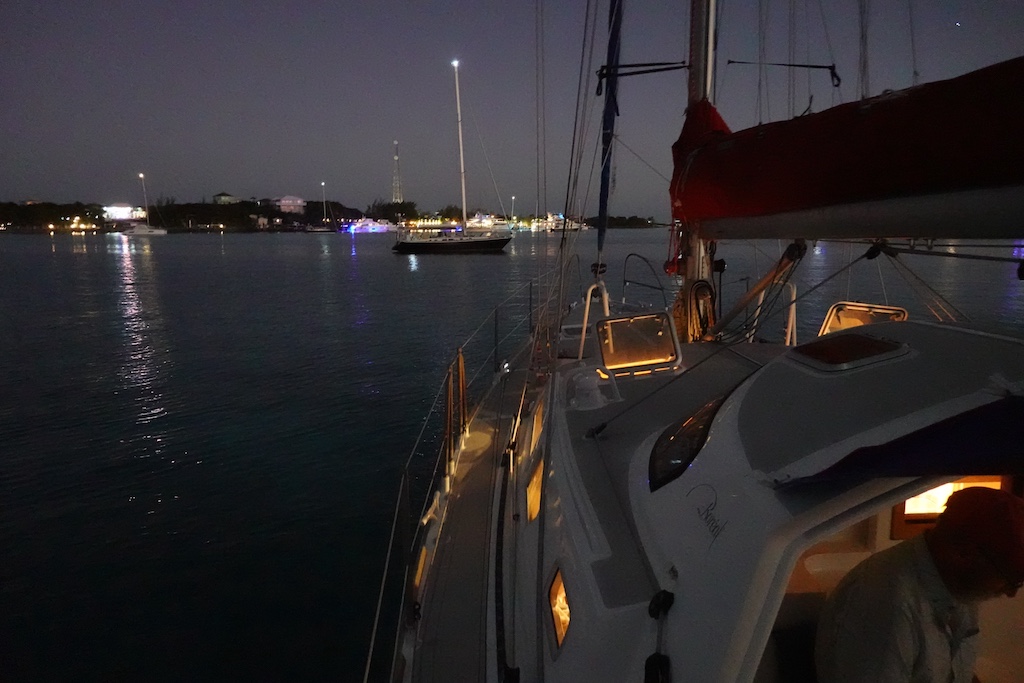
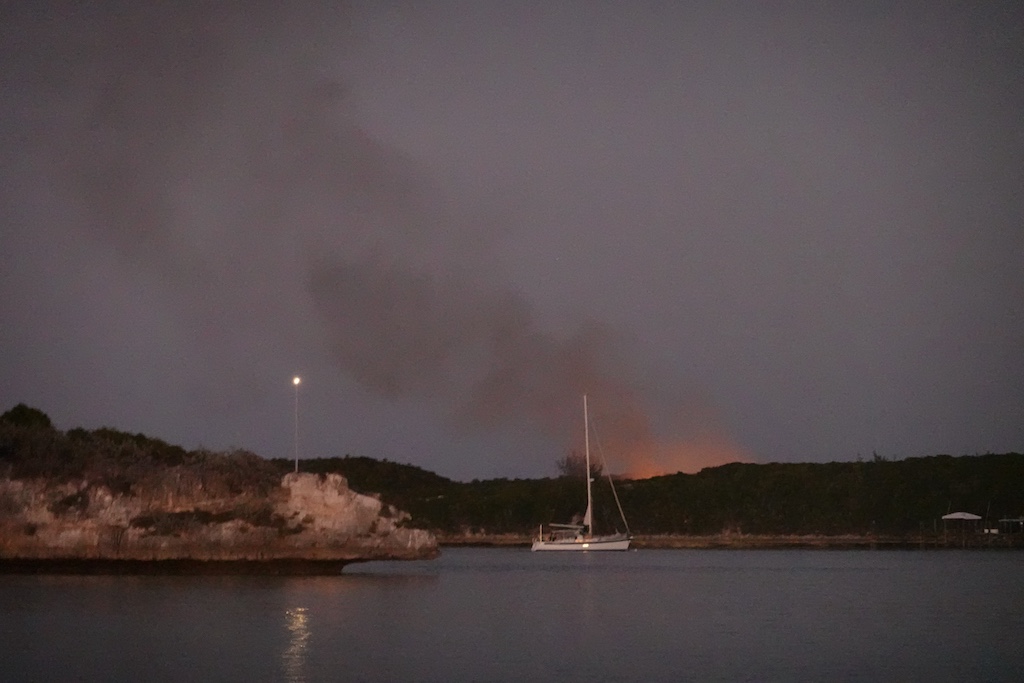
We shifted from our hidey-hole to the more populous west side of the island the next day, after the wind subsided, eyeballing our route very carefully. We spent that evening happily afloat, watching a gorgeous sunset and a big trash fire in the distance. There was also a huge party–maybe a wedding party, from what we could discern through binoculars–making a huge amount of disco boom-box noise at a large fancy holiday house perched on the shore overlooking the anchorage. And this is what chased us to sleep that night.
The following day we became tourists ourselves. First we dinghied past an intriguing wrecked trawler yacht around to the famous Bay of Pigs on the southwest side of Big Majors Cay.
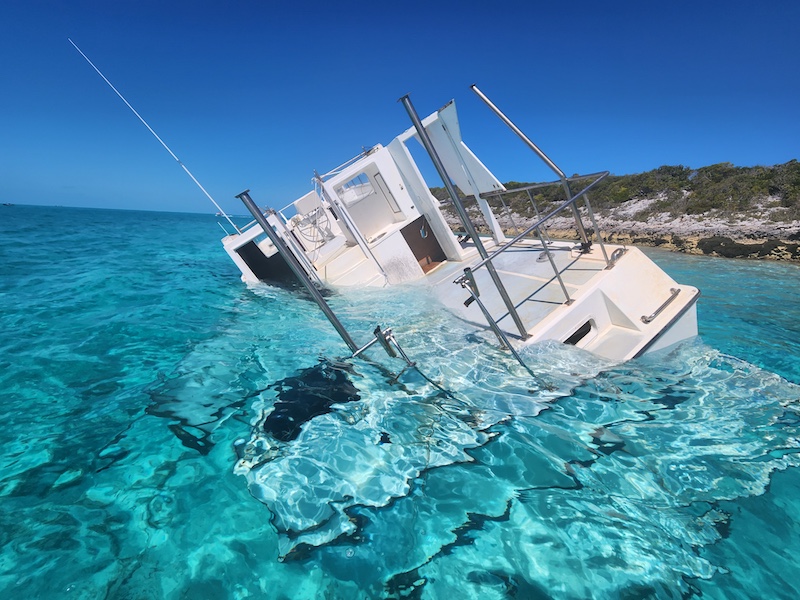
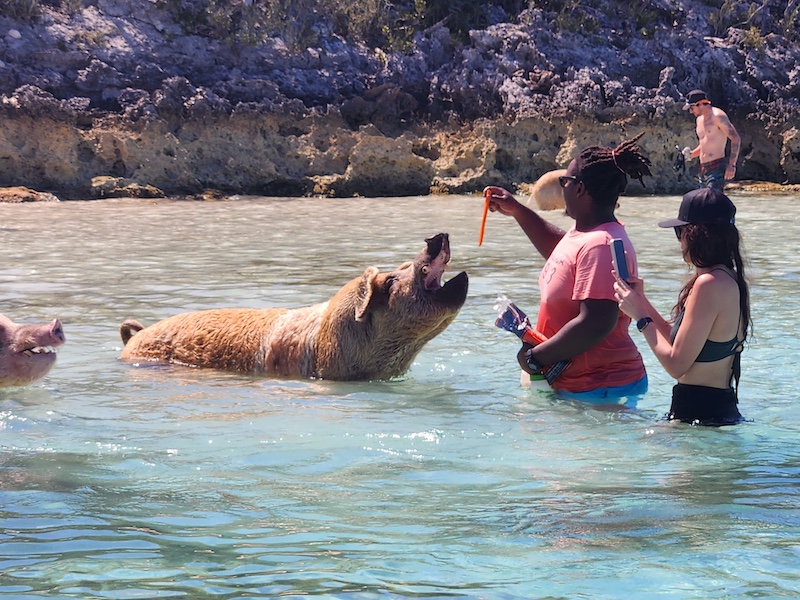
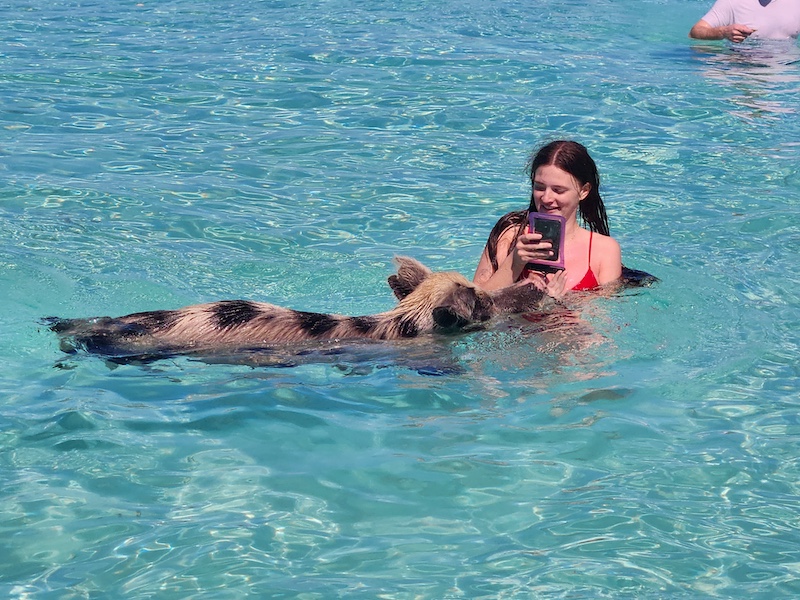
Except for the wreck, it was not exactly an edifying experience.
Later that same day, after carefully gauging the ebb and flow of the touristy dive-boat traffic, Michael and I struck out in the dinghy, anchored it, and snorkeled into the famous Thunderball Grotto, having it all to ourselves for a bit. I don’t have images of this, but can point you to a relevant touristy viddy to give you a sense of the experience:
Much better than the pigs, I’d say.
Departing from Staniel Cay, of course, we had another impending cold front to worry about. The strongest one yet, given how far north we had sailed. We fixed on Eleuthera as a good place to hide from it. Either at Rock Sound Harbour, which was closer and very capacious, with guaranteed enough space to accommodate us and whoever else might choose to hide there. Or Hatchet Bay Harbour, much smaller, more distant, with a very narrow entrance and maybe not enough space for everyone who wanted to hide there.
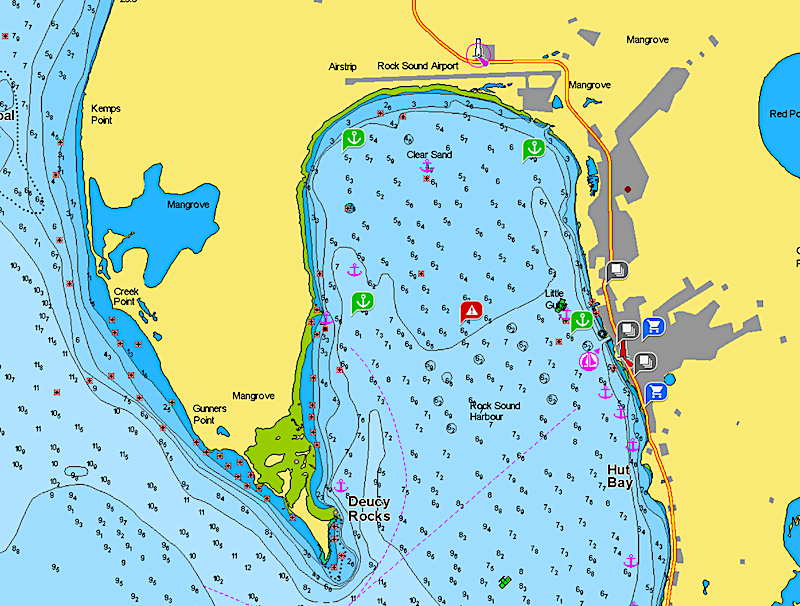
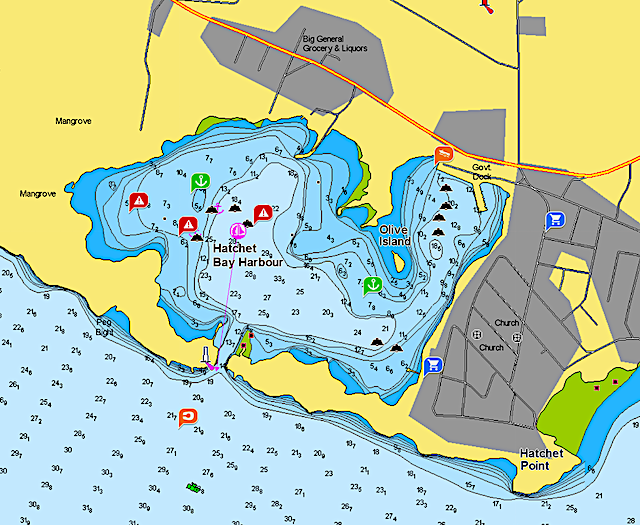
I opted for Hatchet Bay, both because it was closer to where we ultimately wanted to go, and because I hoped our shoal-draft super-power would allow us to drop an anchor somewhere inside, no matter how crowded it was. Sailing across the great Bight of Eleuthera, heading northwest from Davis Channel to get there, was an oddly familiar experience. It reminded me a lot of sailing across Cape Cod Bay, from the Cape Cod Canal to Provincetown. We were always in shoal water–about 20 feet, so we could stop and just anchor most anytime we liked–with a great arm of low land to starboard gradually embracing us as it steadily pushed itself up over the horizon.
Hatchet Bay, as it turned out, was a bridge too far in terms of arriving before sunset. I debated whether we should try and run the entrance in the gathering darkness, aided by a fat moon, but in the end I punted, and we anchored for the night in an open bay just a few miles to the east. Next morning early when we finally entered Hatchet Bay, I saw this had been a wise decision.
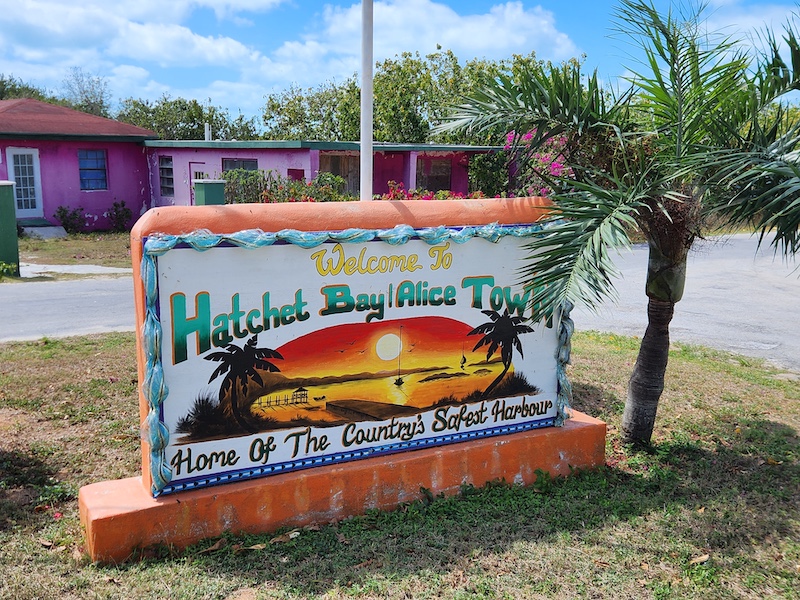
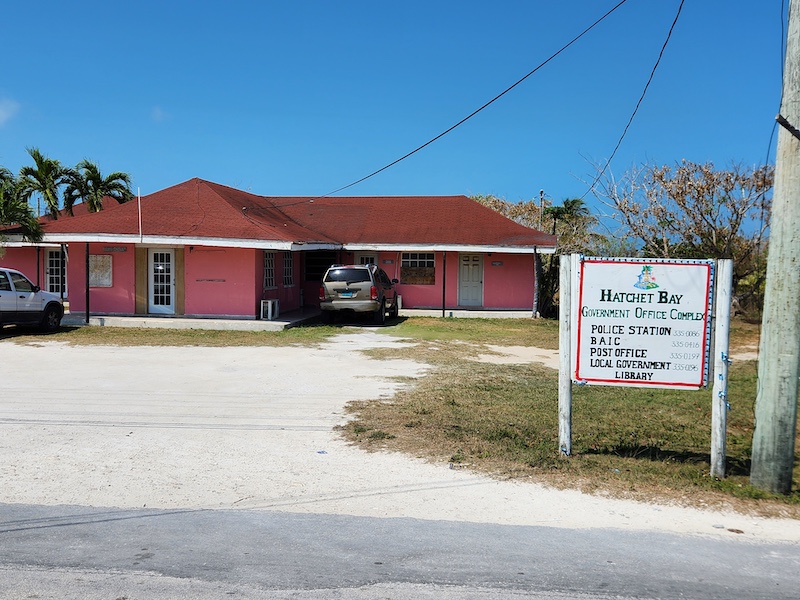
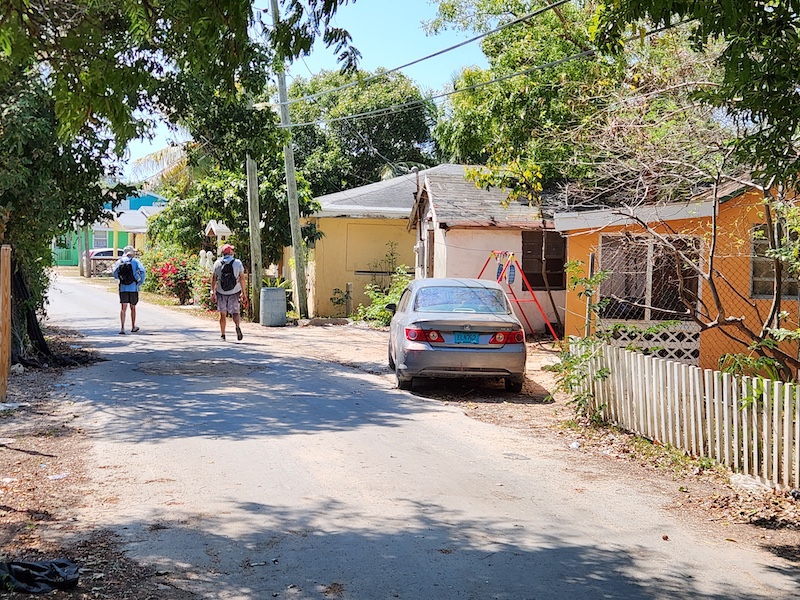
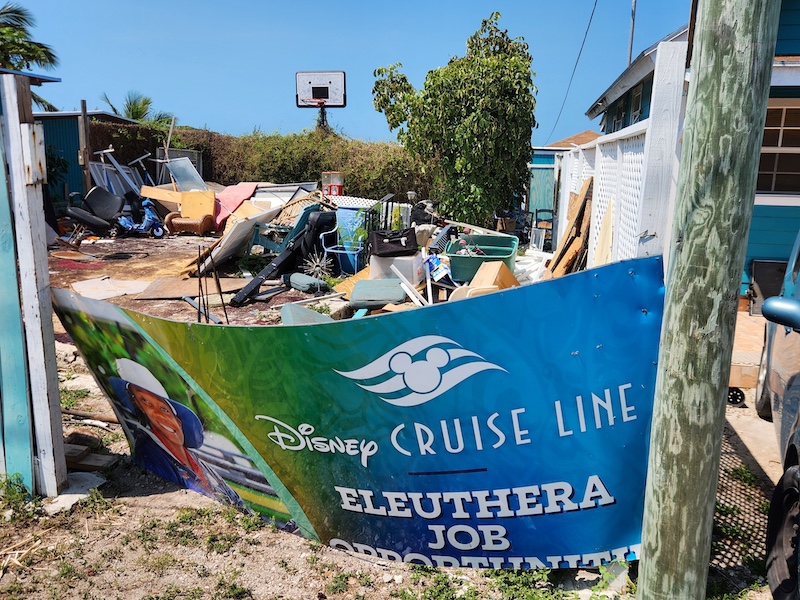
Alice Town, the small village beside Hatchet Bay, seemed an odd mix of both the remote and touristy Bahamas. Interestingly, it was here at Eleuthera that we first encountered the “cruise ship Bahamas.” This in the form of a Disney cruise-ship/tourist enclave that has been established at Lighthouse Point, at the island’s southern tip. We spotted it initially from a distance, the very first lump of Eleuthera sighted as we sailed across Exuma Sound from Staniel Cay. And its influence seemed pervasive, obviously stretching the 55 miles up-island to Alice Town and presumably even further than that.
We waited out the next dose of strong weather with about 20 other boats at Hatchet Bay, and then, happily, given it was by now mid-March, were presented with a weather window wide enough to take us all the way to Georgia. We leapt into it, exiting the Bight of Eleuthera at Current Cut, some 16 miles west of Hatchet Bay and about nine miles south of Spanish Wells.
In all it took us three days—mostly motoring, alas—to cross the Northeast Providence Channel, then run the length of the Northwest Providence Channel, and then transit most of Florida’s east coast. This took us right past Norwegian Cruise Line’s captive Bahamian island, Great Stirrup Cay, and also the city of Freeport, long a major hub for cruise ships.
Down into the Valley of Cruise Ships
Sailed the Good Ship Lunacy
Cruise ships to the right of us
Cruise ships to the left of us
Cruise ships right in front of us
Boldly we sailed and well
Into the mouth of Cruise Ship Hell
(apologies to Alfred Lord Tennyson)
Truly, they are a blight on the planet. We had cruise ships in sight for almost all of our three-day passage, at times as many as eight at once.
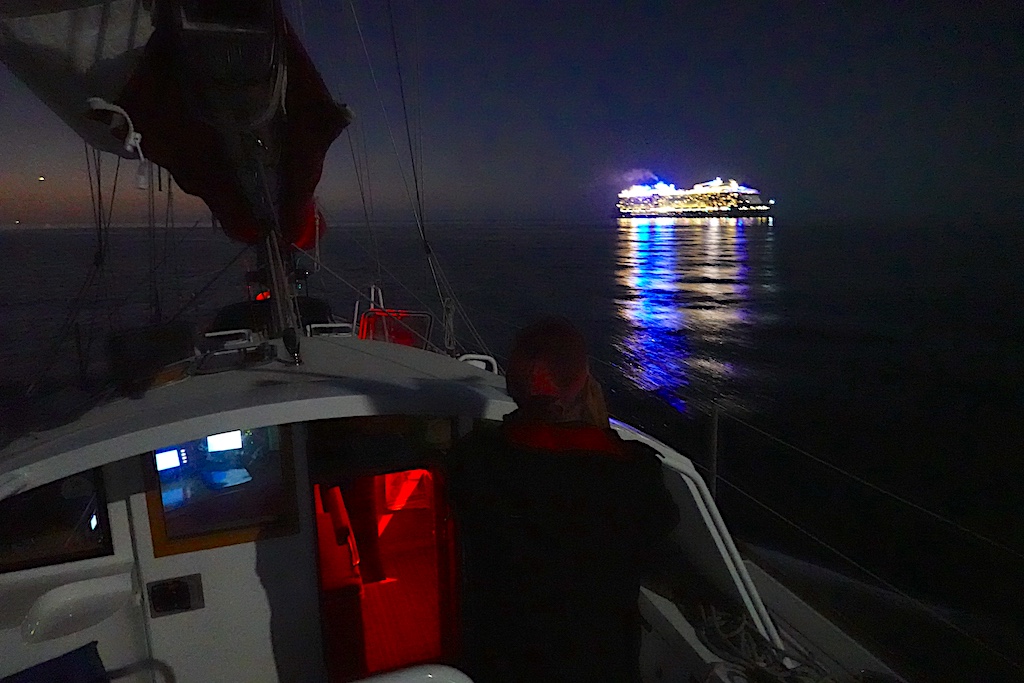
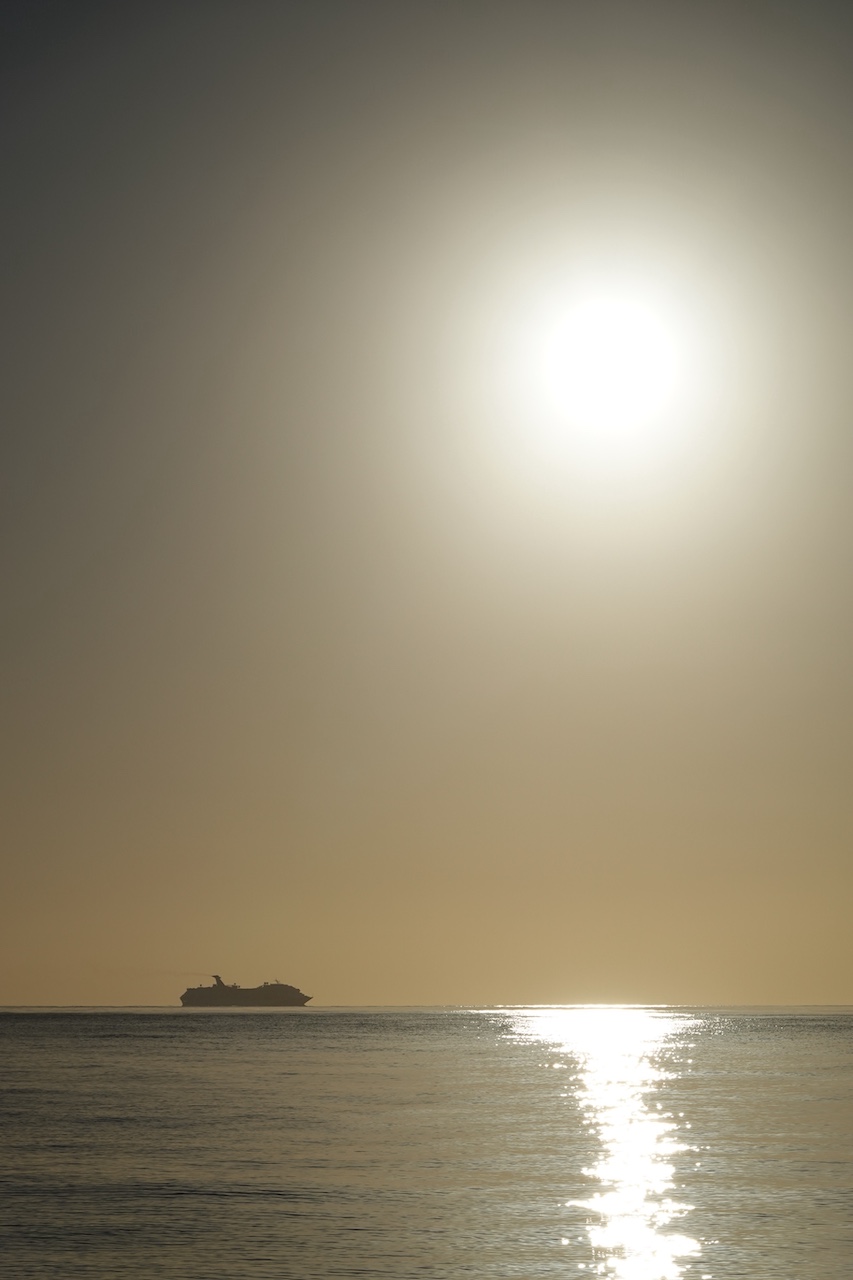
We got a big boost from the Gulf Stream for a while, and I will long remember barely ghosting along, sailing wing-and-wing before a bare breath of a breeze, while making 6-8 knots over the bottom.
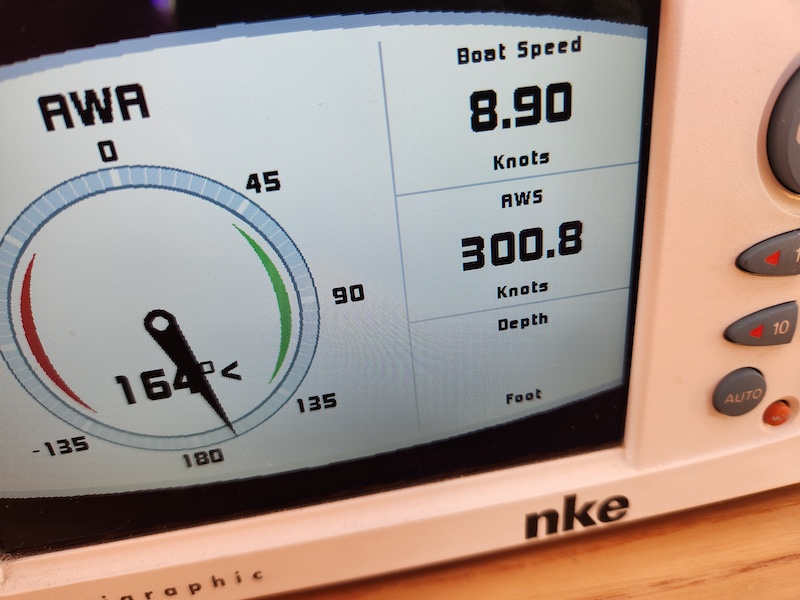
Some of the time we had so little wind, our electronics could make no sense of the data from our masthead sensor.
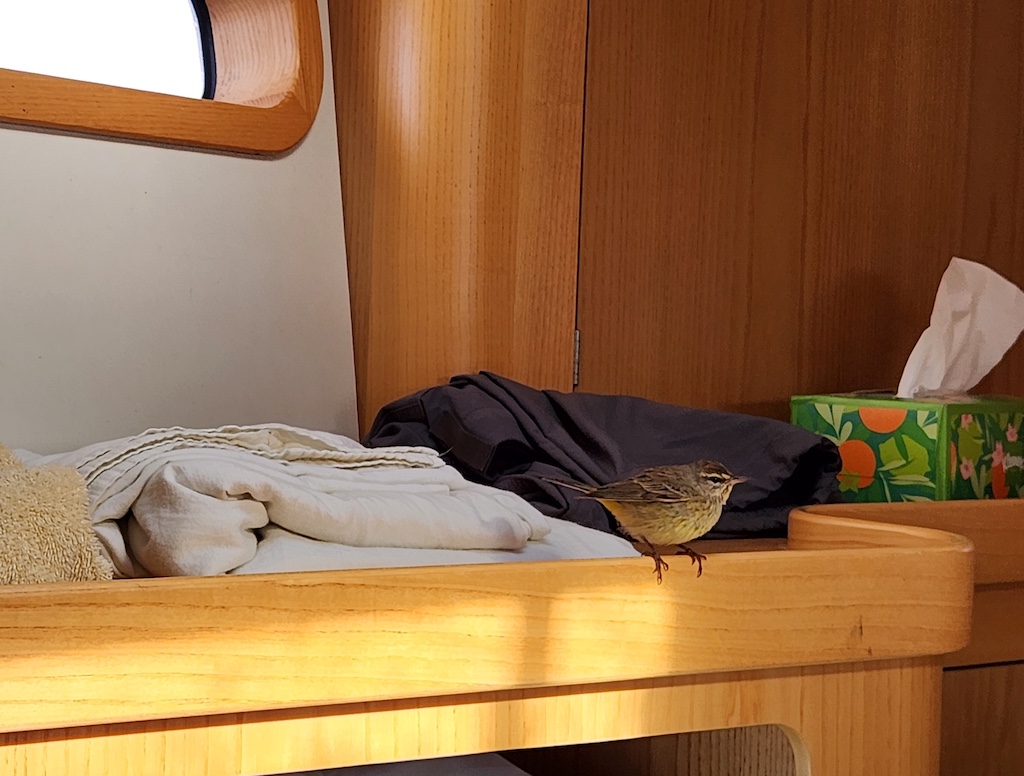
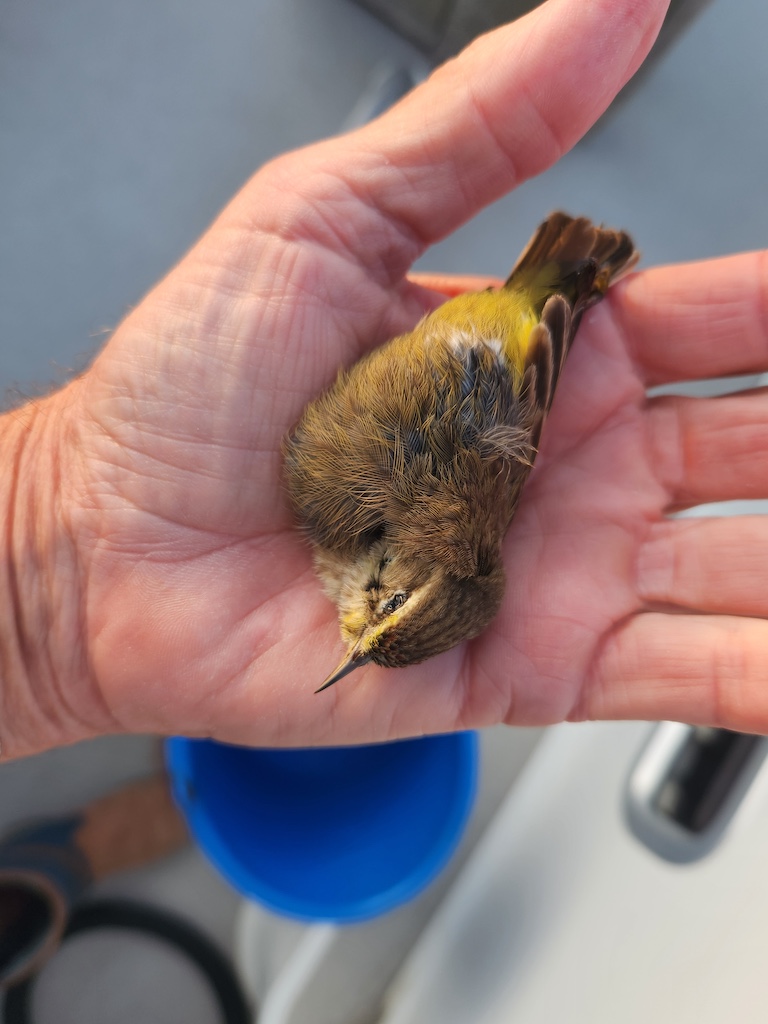
We also were visited by three shore-birds, one of which spent the night aboard, thoroughly exhausted, and was found dead in the morning.
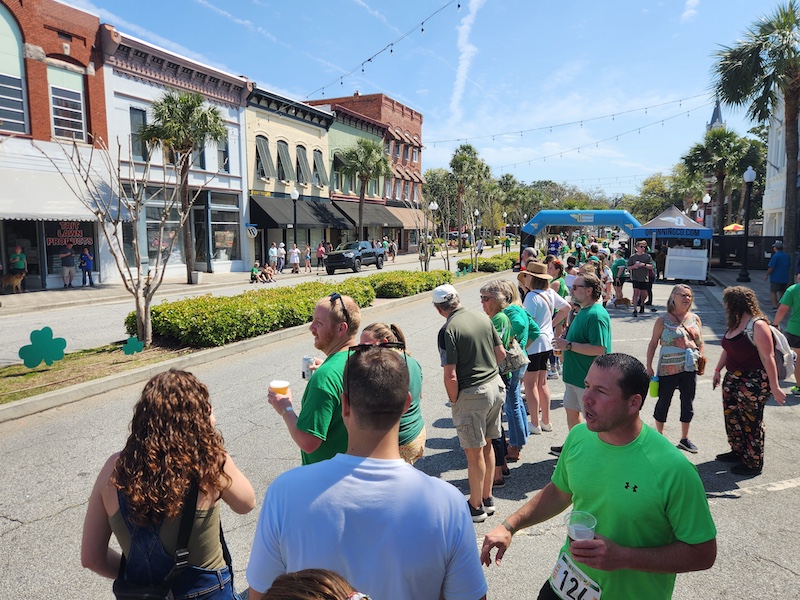
Finally, we did arrive at the Brunswick Landing Marina, just as another cold front started blasting through, and just in time to witness the town of Brunswick’s festive St. Patrick’s Day celebration.
This was Lunacy’s third visit here, and we were pleased to be awarded a spot on dock 1, in company with some very large and fancy classic yachts.
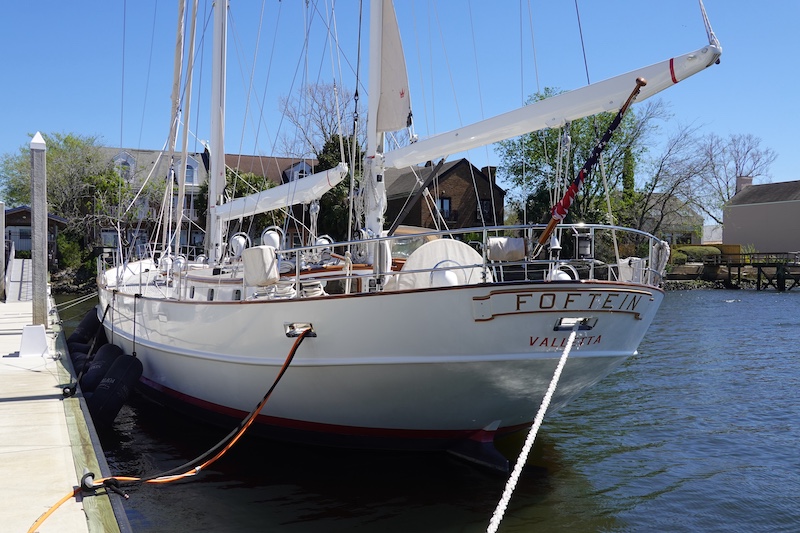
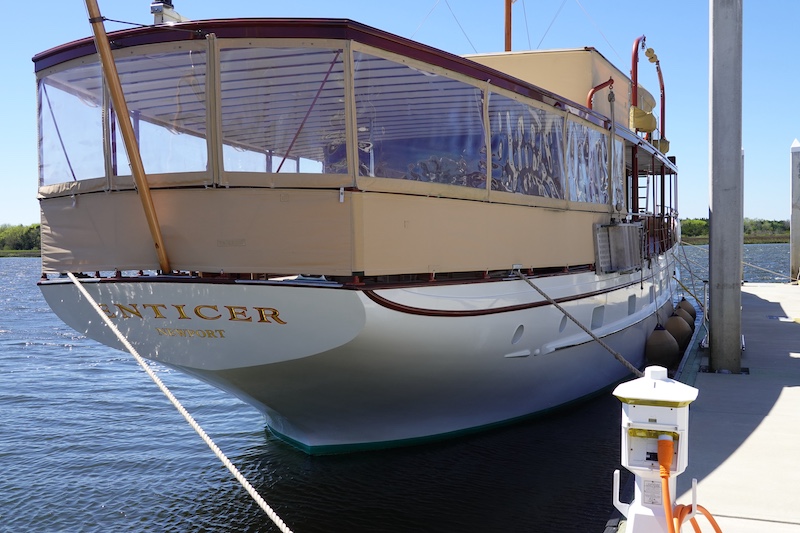
But my personal favorite boat in the marina this time was this one. A plywood RM 1050 from France that appeared to have a liferaft for a dinghy.
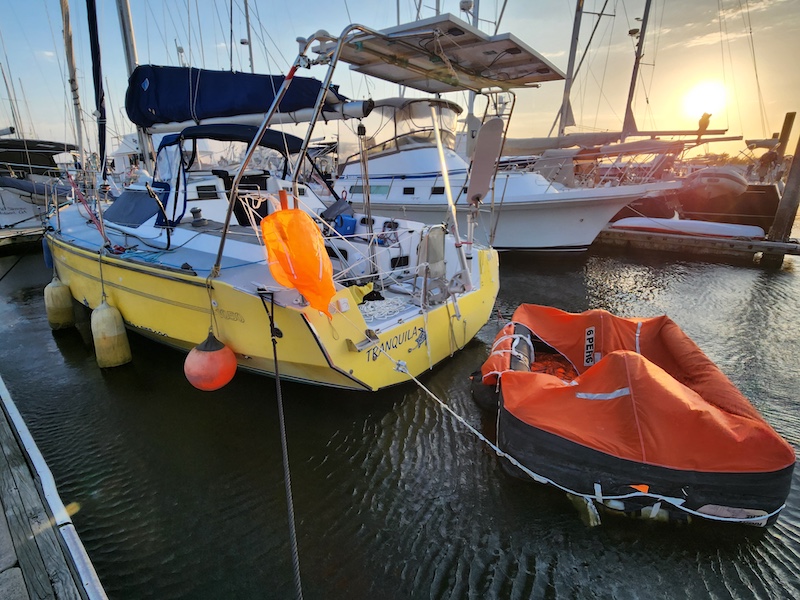
Lunacy is asleep now, awaiting my return, and looks forward to finally coming all the way home in the next month or so.
NOTE: One sad thing that happened in the real world while I was off on this venture was that I got word that Don Casey, a seminal marine journalist I worked with at SAIL for many years, had died suddenly of a heart attack. Fortunately, I was able to send this missive in his memory into the comic. May God go with him.
ALSO: Many thanks to Bill and Michael for all the help they gave me!


Reads like a wonderful trip. Thanks for stopping by Ponce and signing the books
Thank you for staying with us at Brunswick Landing Marina! Come see us again soon 🙂