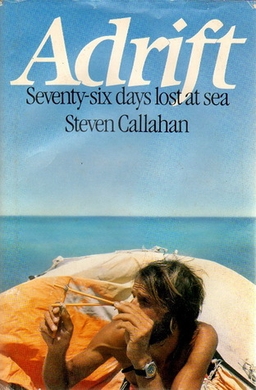
Feb. 2/2025: It is, as Steve Callahan himself once remarked to me, a story that will not die. That being the story of his 76-day solo survival drift across the North Atlantic in a liferaft, back in 1982, after his 21-foot sloop Napoleon Solo was sunk in a collision (presumably with a whale) some distance west of the Canary Islands. Steve’s book about the experience, Adrift: Seventy-Six Days Lost at Sea, spent 36 weeks on the New York Times bestseller list after it was first published in 1986 and has been in print ever since. It is fair to say the book is now firmly embedded in the literature of our sport.
The story’s latest permutation is a recently released documentary film, now making the rounds in boutique theater screenings and film fests, produced and directed by a young filmmaker/screenwriter, Joe Wein. Joe, it seems, stumbled on the story entirely by chance, after picking up a used copy of Steve’s book, and was captivated by it.
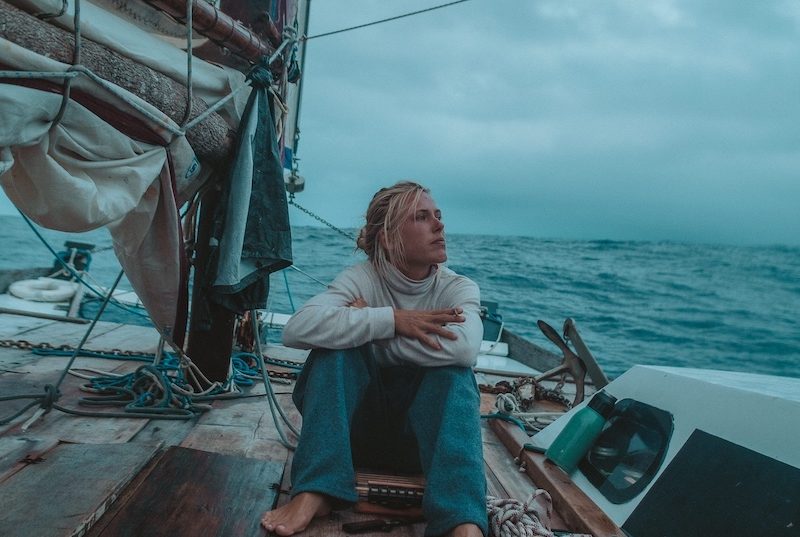
I had a chance to see the film at the Regent Theater in Arlington, Massachusetts, last week and was impressed. I’ve known Steve for years and am very familiar with the story, but still I learned a thing or two. I was particularly blown away early on in the film to see actual footage of Steve sailing on Napoleon Solo in 1981 (see image up top). I’d have thought any film aboard was lost with the boat. But no… it turns out Steve’s then-wife, Frisha Hugessen, visited him in the Canaries shortly before he struck out solo across the Atlantic in January 1982, and this gave him a chance to offload his film archive.
Aside from the “legacy” footage (of which I would have liked to see more), the film is rooted in Steve’s narration, the result of a week’s worth of interviews Joe conducted, some of it decorated with drawings Steve created after his ordeal (some, but not all of which appeared in the book), but most importantly with Joe’s personal recreation of Steve’s ordeal. Joe went to enormous lengths to assemble period-accurate duplicate gear (as documented in this recent Cruising World article) and then personally filmed various aspects of Steve’s experience from an in-raft POV perspective.

Joe with his camera in a 6-man Avon liferaft identical to the one that kept Steve alive during his survival drift. The POV parts of the film were filmed over 17 days off St. Croix, with help from Steve’s old friend, Roger Hatfield, of Gold Coast Yachts
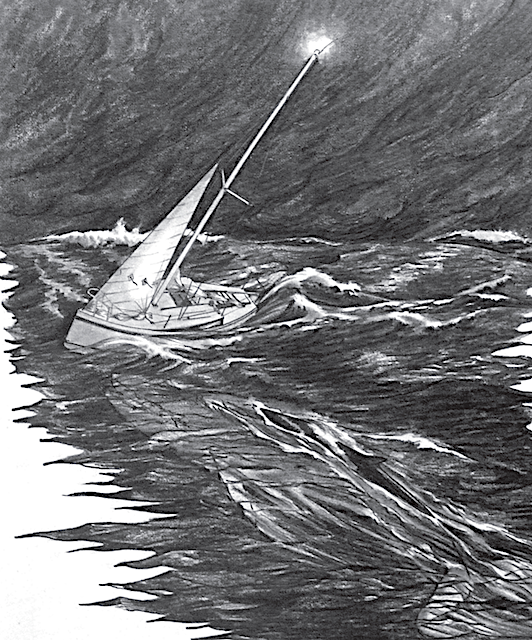
Steve’s speculative drawing, depicting the immediate prelude to the presumed collision with a whale that sunk his boat
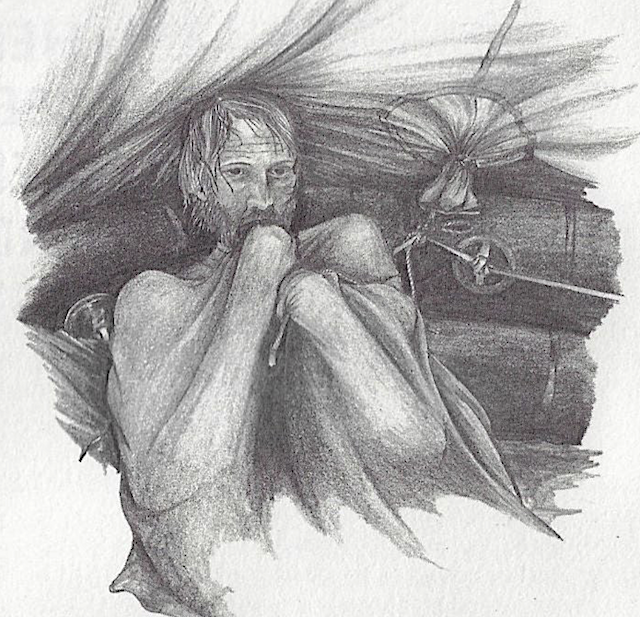
Steve’s drawing of himself aboard his raft, which he christened Rubber Ducky
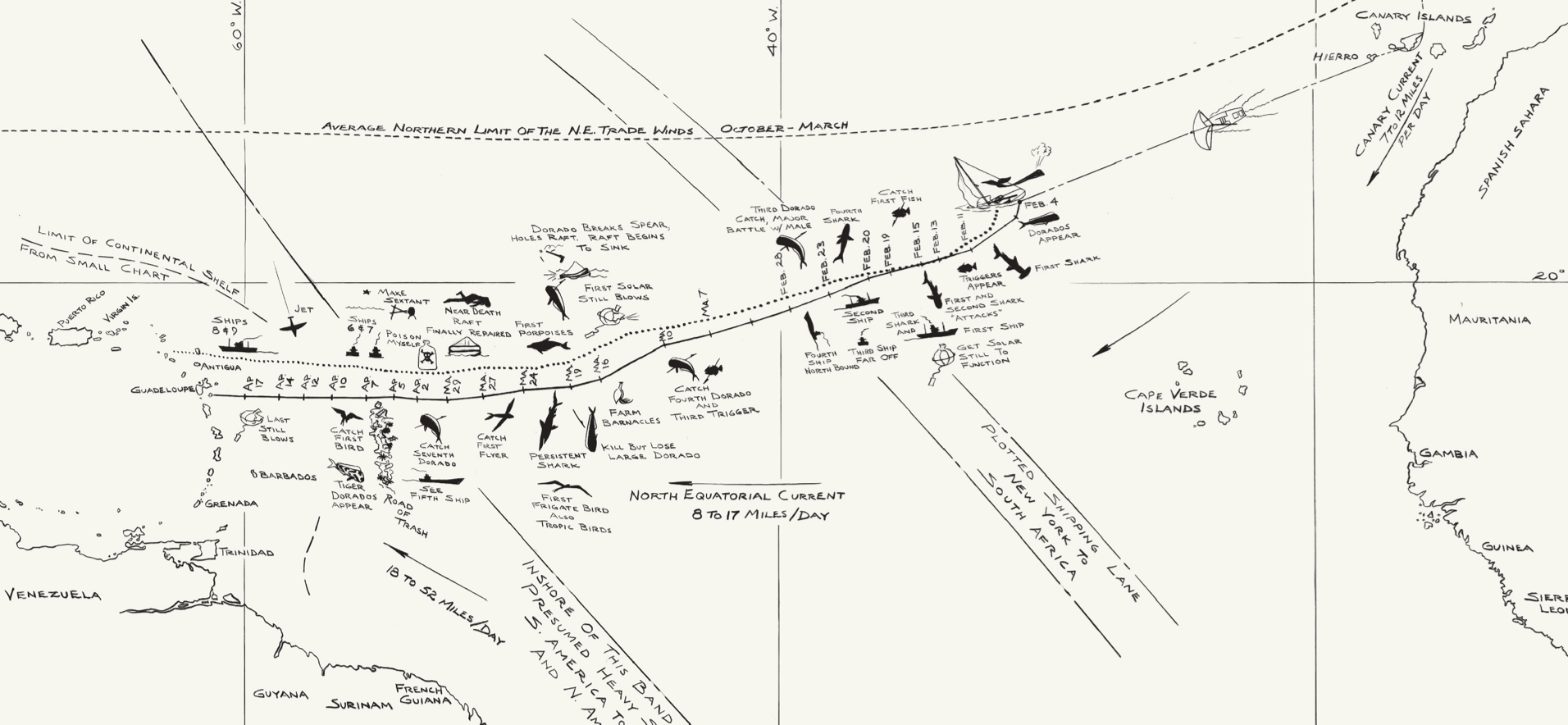
Steve’s sketch chart of his drift across the Atlantic
Steve’s survival-drift experience, the great undying story, has defined his life in several different ways. He co-wrote a book, Capsized, about another survival drift in which four men spent 119 days in a flipped trimaran. He has delivered many lectures on survival over the years, and he consulted in detail on survival at sea with director Ang Lee and cast during the filming of Lee’s popular film Life of Pi, as well as on other film and video projects. (It was the Pi connection that inspired Ang Lee to helpfully lend his name to Joe’s project as a co-producer.) A naval architect who both designed and built Napoleon Solo himself, Steve also later designed and helped nurse into production (for a little while anyway) a folding RIB yacht tender he called the Clam. This was a sailable, rowable dinghy that could also be tricked out as a survival pod—exactly the sort of vessel Steve wished he’d been on instead of his raft back in 1982.
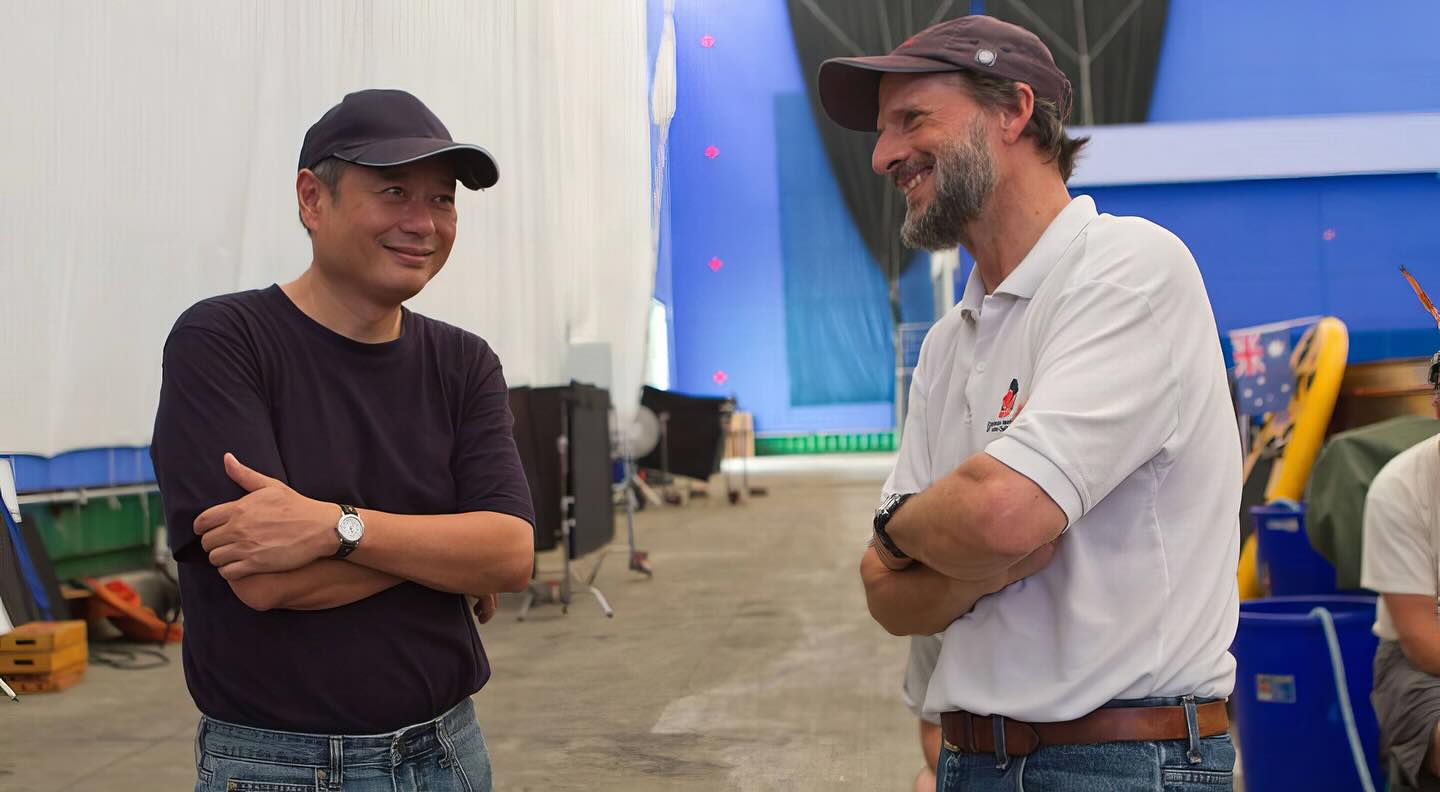
Steve and Ang Lee during the filming of Life of Pi
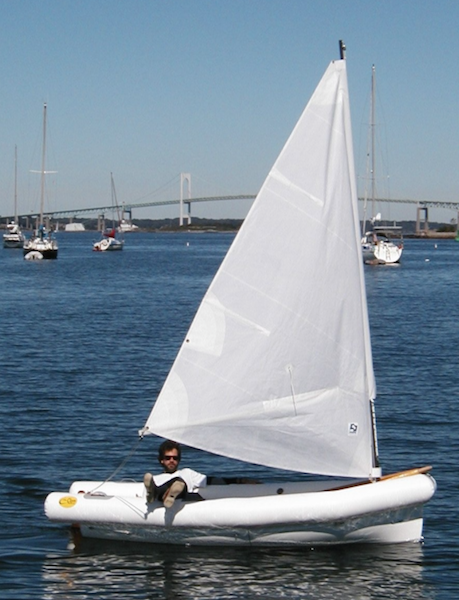
A much younger me test-sailing a prototype of Steve’s Clam back in 1998
What most people don’t know is that Steve had another near-death survival experience many years after the sinking of Napoleon Solo. This was a very serious bout with leukemia, where Steve was the only survivor of a clinical trial in which he received a life-saving stem-cell transplant from a donated umbilical cord. I immediately thought of this after watching the film and called Steve to ask: did you not relate these two experiences to each other???
Of course he did.
Immediately on receiving his leukemia diagnosis, Steve told me, he mentally switched into the survival mindset that had sustained him in the raft. As in: first and foremost, you must accept the awful fact of the situation, that you may well not survive. Second, you must do all you can to positively affect those factors over which you have some control. Third, you must cope as best you can with those factors over which you have no control. And then you maintain as long as possible. The biggest difference between surviving the raft and surviving the cancer, Steve allowed, was that in the raft he had to rely solely upon himself, while with the cancer he had to rely almost entirely on others. Which in certain ways, I would presume, made the second experience a bit harder than the first.
In the end, Steve freely admits, he was very lucky both times.
One could probably make a very interesting film explicitly documenting and comparing Steve’s two survival experiences, but meanwhile you should do what you can to catch this one about the raft. Check out the schedule on the film’s website and keep your fingers crossed we’ll be able to stream it online sometime soon.